find an equation for a negative cosine function having an amplitude of 3, a period of $pisqrt{2}$, and a…
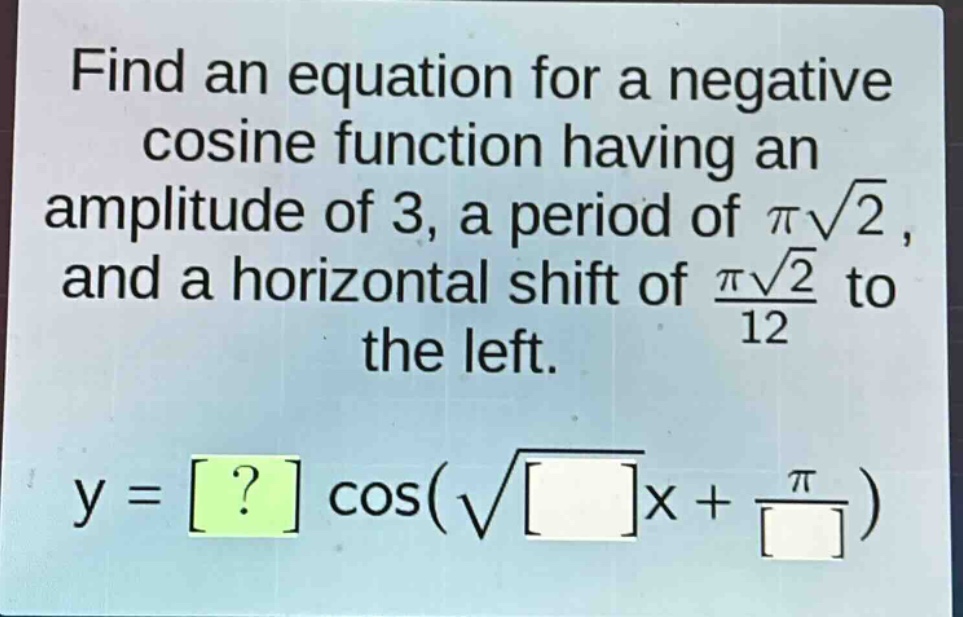
find an equation for a negative cosine function having an amplitude of 3, a period of $pisqrt{2}$, and a horizontal shift of $\frac{pisqrt{2}}{12}$ to the left.\n$y = ? cos(sqrt{}x+\frac{pi}{})$
Answer
Explanation:
Step1: Determine the amplitude
The general form of a cosine - function is $y = A\cos(Bx - C)+D$. Given that the amplitude is 3 and it is a negative cosine function, so $A=- 3$.
Step2: Find the value of B
The period formula for a cosine function is $T=\frac{2\pi}{|B|}$. Given $T = \pi\sqrt{2}$, we have $\pi\sqrt{2}=\frac{2\pi}{|B|}$. Solving for $|B|$: [ \begin{align*} |B|&=\frac{2\pi}{\pi\sqrt{2}}\ |B|&=\sqrt{2} \end{align*} ] Since there is no other information suggesting a negative $B$ value for the non - phase - shifted part of the function, we take $B = \sqrt{2}$.
Step3: Determine the value of C
The horizontal shift is given by the formula $h=\frac{C}{B}$. The function is shifted $\frac{\pi\sqrt{2}}{12}$ to the left. For a left - shift, $h<0$. Since $B=\sqrt{2}$, and $h =-\frac{\pi\sqrt{2}}{12}$, and $h=\frac{C}{B}$, then $C = Bh$. Substituting the values of $B$ and $h$: [ \begin{align*} C&=\sqrt{2}\times(-\frac{\pi\sqrt{2}}{12})\ C&=-\frac{\pi}{6} \end{align*} ] The function in the form $y = A\cos(Bx - C)$ becomes $y=-3\cos(\sqrt{2}x+\frac{\pi}{6})$.
Answer:
$y=-3\cos(\sqrt{2}x+\frac{\pi}{6})$