find an equation for the sine graph, f(x):\nwrite your answer in the form f(x) = a sin (bx + c) + d, where…
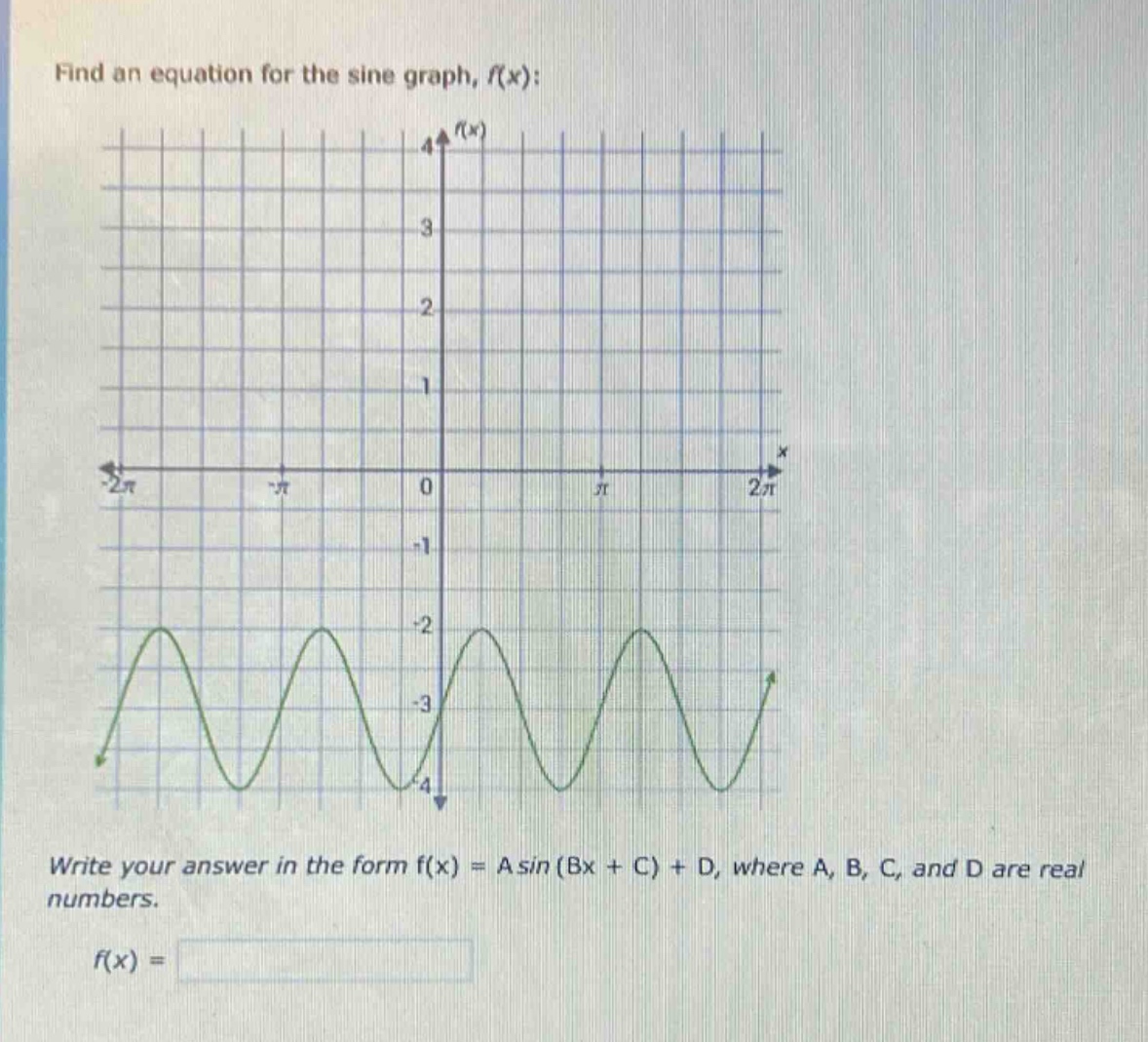
find an equation for the sine graph, f(x):\nwrite your answer in the form f(x) = a sin (bx + c) + d, where a, b, c, and d are real numbers.\nf(x) =
Answer
Answer:
$f(x)= 2\sin(2x)+(- 3)$
Explanation:
Step1: Find the amplitude A
The amplitude is half the vertical distance between the maximum and minimum values. The maximum value is - 1 and the minimum is - 5. So, $A=\frac{|-1-(-5)|}{2}=\frac{4}{2} = 2$.
Step2: Find the period and B
The period of a sine - function is given by $T=\frac{2\pi}{|B|}$. The graph repeats itself over an interval of $\pi$. So, $\pi=\frac{2\pi}{|B|}$, which gives $|B| = 2$. Since the graph has a normal left - to - right orientation, $B = 2$.
Step3: Find the phase shift C
The graph passes through the origin in its "un - shifted" position for a sine function of the form $y = A\sin(Bx)+D$. So, $C = 0$.
Step4: Find the vertical shift D
The mid - line of the graph is $y=-3$. So, $D=-3$.