find an equation for the sine graph, ( f(x) ):\nwrite your answer in the form ( f(x)=a sin (b x+c)+d )…
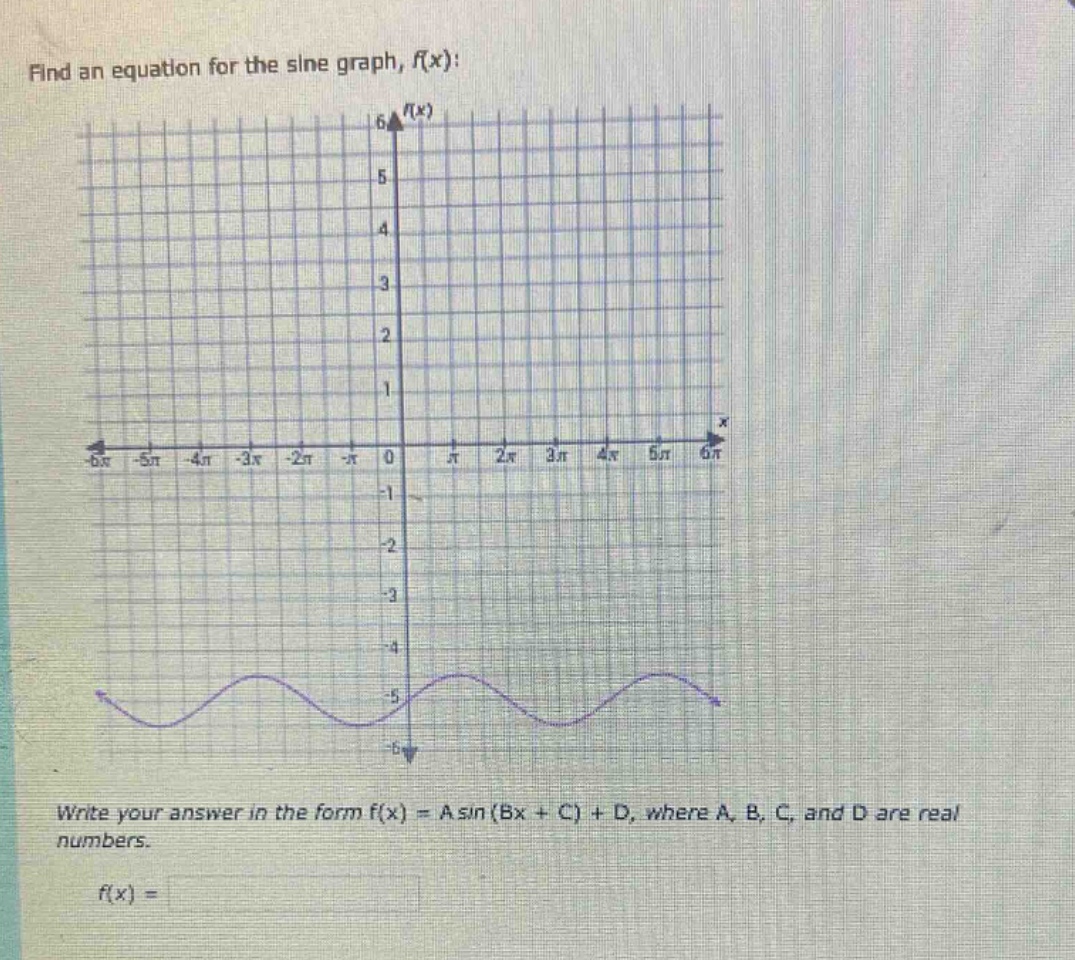
find an equation for the sine graph, ( f(x) ):\nwrite your answer in the form ( f(x)=a sin (b x+c)+d ), where ( a, b, c ), and ( d ) are real numbers.\n( f(x)= )
Answer
Explanation:
Step1: Find the amplitude (A)
The formula for amplitude is (A=\frac{\text{Max}-\text{Min}}{2}). From the graph, (\text{Max}=-4), (\text{Min}=-6). (A=\frac{-4 - (-6)}{2}=\frac{2}{2} = 1)
Step2: Find the vertical shift (D)
The formula for vertical shift is (D=\frac{\text{Max}+\text{Min}}{2}). (D=\frac{-4+(-6)}{2}=\frac{-10}{2}=-5)
Step3: Find the period (T) and (B)
The standard form of a sine function is (y = A\sin(Bx + C)+D), and the period (T=\frac{2\pi}{|B|}). From the graph, the period (T = 4\pi). Since (T=\frac{2\pi}{|B|}), then (4\pi=\frac{2\pi}{|B|}), solving for (B) gives (|B|=\frac{2\pi}{4\pi}=\frac{1}{2}).
Step4: Find the phase shift (using a key - point)
We know the general form (y = A\sin(Bx + C)+D). Let's use the fact that when (x = 0), (y=-5) (a mid - point). Substitute (A = 1), (B=\frac{1}{2}), (D=-5) into (y = A\sin(Bx + C)+D): (-5=1\times\sin(\frac{1}{2}\times0 + C)-5) (\sin(C)=0), we can take (C = 0) (since (\sin(0)=0))
Answer:
(f(x)=\sin(\frac{1}{2}x)-5)