find an equation for a sinusoidal function that has period $\frac{3pi}{2}$, amplitude $\frac{1}{2}$, and…
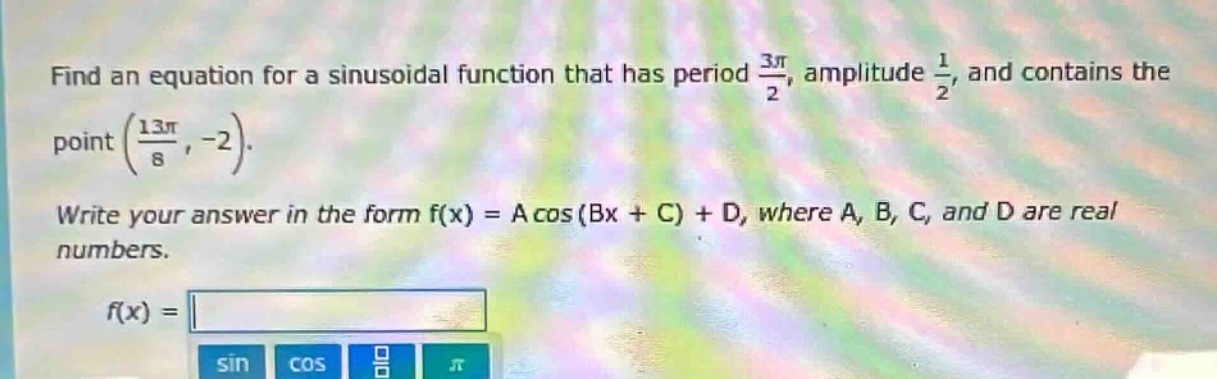
find an equation for a sinusoidal function that has period $\frac{3pi}{2}$, amplitude $\frac{1}{2}$, and contains the point $(\frac{13pi}{8}, - 2)$. write your answer in the form $f(x)=acos(bx + c)+d$, where $a$, $b$, $c$, and $d$ are real numbers. $f(x)=$
Answer
Explanation:
Step1: Find the value of B
The period formula for a cosine - type function $y = A\cos(Bx + C)+D$ is $T=\frac{2\pi}{|B|}$. Given $T = \frac{3\pi}{2}$, we have $\frac{2\pi}{|B|}=\frac{3\pi}{2}$. Solving for $|B|$: Cross - multiply gives $3\pi|B| = 4\pi$, so $|B|=\frac{4}{3}$. Since we can choose the sign of $B$ for simplicity, let $B=\frac{4}{3}$.
Step2: Determine the value of A
The amplitude of the function $y = A\cos(Bx + C)+D$ is $|A|$. Given that the amplitude is $\frac{1}{2}$, so $A=\pm\frac{1}{2}$.
Step3: Find the value of D
The mid - line of the cosine function $y = A\cos(Bx + C)+D$ is $y = D$. Since the cosine function oscillates between $D + A$ and $D - A$, and we know the amplitude and a point on the function. The general range of $y = A\cos(Bx + C)+D$ is $[D - |A|,D + |A|]$. Let's assume the function has a vertical shift. The cosine function has a range of $[- 1,1]$, and our function has an amplitude of $\frac{1}{2}$. Let's substitute the point $x=\frac{13\pi}{8}$ and $y = - 2$ into $y=A\cos(Bx + C)+D$. First, when $A=\frac{1}{2}$ and $B = \frac{4}{3}$, we have $y=\frac{1}{2}\cos(\frac{4}{3}x + C)+D$. Substitute $x=\frac{13\pi}{8}$: $\frac{4}{3}x=\frac{4}{3}\times\frac{13\pi}{8}=\frac{13\pi}{6}$. We know that the cosine function has a range. Let's assume the mid - line $D$ is such that when we substitute the point. Since the amplitude is $\frac{1}{2}$, and the point $(\frac{13\pi}{8},-2)$ lies on the function. The range of $y=\frac{1}{2}\cos(\frac{4}{3}x + C)+D$ is $[D-\frac{1}{2},D + \frac{1}{2}]$. We want to find $D$ such that $\frac{1}{2}\cos(\frac{4}{3}x + C)+D=-2$ at $x = \frac{13\pi}{8}$. The cosine function $\cos t$ has a range of $[-1,1]$. Let's assume $\cos(\frac{4}{3}x + C)=-1$ (to get the minimum value of the cosine - type function). Then $y=-\frac{1}{2}+D$. Since $y=-2$, we can solve for $D$: $-\frac{1}{2}+D=-2$, so $D=-\frac{3}{2}$.
Step4: Find the value of C
Substitute $A=\frac{1}{2}$, $B=\frac{4}{3}$, $D = -\frac{3}{2}$, and the point $(\frac{13\pi}{8},-2)$ into $y = A\cos(Bx + C)+D$. We have $-2=\frac{1}{2}\cos(\frac{4}{3}\times\frac{13\pi}{8}+C)-\frac{3}{2}$. First, simplify $\frac{4}{3}\times\frac{13\pi}{8}=\frac{13\pi}{6}$. Then the equation becomes $-2=\frac{1}{2}\cos(\frac{13\pi}{6}+C)-\frac{3}{2}$. Add $\frac{3}{2}$ to both sides: $-2+\frac{3}{2}=\frac{1}{2}\cos(\frac{13\pi}{6}+C)$, so $-\frac{1}{2}=\frac{1}{2}\cos(\frac{13\pi}{6}+C)$. Then $\cos(\frac{13\pi}{6}+C)=-1$. We know that $\cos t=-1$ when $t=(2k + 1)\pi,k\in\mathbb{Z}$. Let $k = 0$, then $\frac{13\pi}{6}+C=\pi$. Solve for $C$: $C=\pi-\frac{13\pi}{6}=-\frac{7\pi}{6}$.
So the function is $f(x)=\frac{1}{2}\cos(\frac{4}{3}x-\frac{7\pi}{6})-\frac{3}{2}$.
Answer:
$f(x)=\frac{1}{2}\cos(\frac{4}{3}x-\frac{7\pi}{6})-\frac{3}{2}$