find an equation for a sinusoidal function that has period $pi$, amplitude 3, and contains the point…
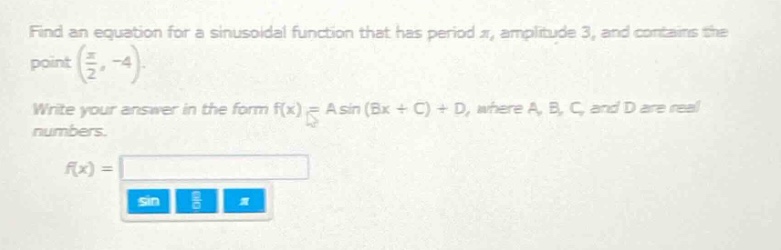
find an equation for a sinusoidal function that has period $pi$, amplitude 3, and contains the point $(\frac{pi}{2}, - 4)$. write your answer in the form $f(x)=asin(bx + c)+d$, where $a$, $b$, $c$, and $d$ are real numbers. $f(x)=$
Answer
Explanation:
Step1: Find the value of B
The period formula for a sinusoidal function $y = A\sin(Bx + C)+D$ is $T=\frac{2\pi}{B}$. Given $T = \pi$, we have $\pi=\frac{2\pi}{B}$. Solving for B gives $B = 2$.
Step2: Determine the value of A
The amplitude is given by $|A|$. Since the amplitude is 3, $A=\pm3$.
Step3: Find the value of D
The mid - line of the sinusoidal function is $y = D$. For a general sinusoidal function, the range is $[D - |A|,D + |A|]$. Since the amplitude $|A| = 3$, and we know the function passes through $(\frac{\pi}{2},-4)$. Let's assume $A=- 3$ (we can make this assumption based on the point's position). The general form of the function is $y=-3\sin(2x + C)+D$. The mid - line of the sine function is the average of the maximum and minimum values. For a sine function with amplitude 3, if we consider the fact that the function passes through $(\frac{\pi}{2},-4)$, we know that the mid - line $D=-1$.
Step4: Find the value of C
Substitute $x=\frac{\pi}{2}$, $y = - 4$, $A=-3$, $B = 2$ and $D=-1$ into $y=A\sin(Bx + C)+D$. We get $-4=-3\sin(2\times\frac{\pi}{2}+C)-1$. First, simplify the equation: $-4=-3\sin(\pi + C)-1$. Add 1 to both sides: $-3=-3\sin(\pi + C)$. Then $\sin(\pi + C)=1$. Using the trigonometric identity $\sin(\pi+\alpha)=-\sin\alpha$, we have $-\sin C = 1$, so $\sin C=-1$. Then $C=\frac{3\pi}{2}+2k\pi,k\in\mathbb{Z}$. We can take $k = 0$ and $C=\frac{3\pi}{2}$. So the function is $f(x)=-3\sin(2x+\frac{3\pi}{2})-1$.
Answer:
$f(x)=-3\sin(2x+\frac{3\pi}{2})-1$