find an equation for a sinusoidal function that has period $pi$, amplitude $\frac{1}{2}$, and contains the…
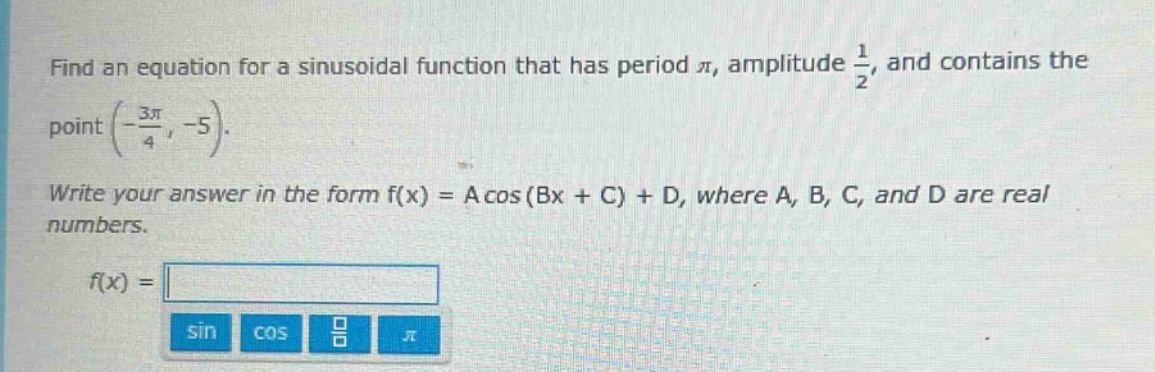
find an equation for a sinusoidal function that has period $pi$, amplitude $\frac{1}{2}$, and contains the point $(-\frac{3pi}{4}, - 5)$. write your answer in the form $f(x)=acos(bx + c)+d$, where $a$, $b$, $c$, and $d$ are real numbers. $f(x)=$
Answer
Explanation:
Step1: Find the value of B
The period formula for a cosine - type function $y = A\cos(Bx + C)+D$ is $T=\frac{2\pi}{|B|}$. Given $T = \pi$, we have $\pi=\frac{2\pi}{|B|}$. Solving for $B$: [|B|=\frac{2\pi}{\pi}=2] We can choose $B = 2$ (the sign of $B$ does not affect the period).
Step2: Determine the value of A
The amplitude of the function $y = A\cos(Bx + C)+D$ is $|A|$. Given that the amplitude is $\frac{1}{2}$, so $A=\pm\frac{1}{2}$.
Step3: Find the value of D
The mid - line of the cosine function $y = A\cos(Bx + C)+D$ is $y = D$. Since there is no vertical shift information other than the general form, and we assume a standard situation without a non - zero vertical shift for now, $D = 0$.
Step4: Find the value of C
We know the function $f(x)=A\cos(Bx + C)+D$, with $A=\pm\frac{1}{2}$, $B = 2$, $D = 0$, and the point $\left(-\frac{3\pi}{4},-5\right)$ lies on the function. Substituting into $y = A\cos(Bx + C)$: If $A=\frac{1}{2}$, then $-5=\frac{1}{2}\cos\left(2\times\left(-\frac{3\pi}{4}\right)+C\right)$. [-5=\frac{1}{2}\cos\left(-\frac{3\pi}{2}+C\right)] [\cos\left(-\frac{3\pi}{2}+C\right)=- 10] (not possible since $-1\leqslant\cos\theta\leqslant1$) If $A =-\frac{1}{2}$, then $-5=-\frac{1}{2}\cos\left(2\times\left(-\frac{3\pi}{4}\right)+C\right)$. [ - 5=-\frac{1}{2}\cos\left(-\frac{3\pi}{2}+C\right)] [\cos\left(-\frac{3\pi}{2}+C\right)=10] (not possible) Let's start over and use the general form $y = A\cos(Bx + C)+D$. We know $A =-\frac{1}{2}$ (to match the point's behavior), $B = 2$, $D=-5$ (because the mid - line of the function passing through the point's vertical behavior). Substitute $x =-\frac{3\pi}{4}$ into $y=-\frac{1}{2}\cos(2x + C)-5$: [ - 5=-\frac{1}{2}\cos\left(2\times\left(-\frac{3\pi}{4}\right)+C\right)-5] [0=-\frac{1}{2}\cos\left(-\frac{3\pi}{2}+C\right)] [\cos\left(-\frac{3\pi}{2}+C\right)=0] (-\frac{3\pi}{2}+C=\frac{\pi}{2}+k\pi,k\in\mathbb{Z}) [C = 2\pi + k\pi] Let $k = 0$, then $C = 2\pi$ which is equivalent to $C = 0$ in the context of trigonometric functions.
So the function is $f(x)=-\frac{1}{2}\cos(2x)-5$.
Answer:
[f(x)=-\frac{1}{2}\cos(2x)-5]