find the exact value of \\( \\csc \\theta \\), given that \\( \\cot \\theta=-\\frac{1}{4} \\) and \\(…
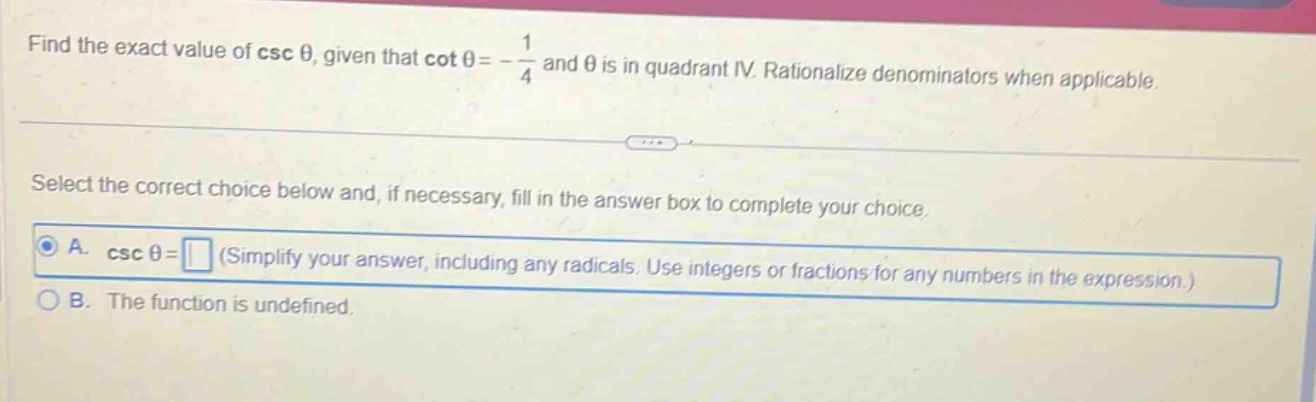
find the exact value of \\( \\csc \\theta \\), given that \\( \\cot \\theta=-\\frac{1}{4} \\) and \\( \\theta \\) is in quadrant iv. rationalize denominators when applicable. select the correct choice below and, if necessary, fill in the answer box to complete your choice. a. \\( \\csc \\theta= \\) (simplify your answer, including any radicals. use integers or fractions for any numbers in the expression.) b. the function is undefined.
Answer
Explanation:
Step1: Use the Pythagorean identity
We know the identity (1+\cot^{2}\theta=\csc^{2}\theta). Given (\cot\theta =-\frac{1}{4}), substitute it into the identity: (1+\left(-\frac{1}{4}\right)^{2}=\csc^{2}\theta).
Step2: Simplify the left - hand side
Calculate (\left(-\frac{1}{4}\right)^{2}=\frac{1}{16}), then (1+\frac{1}{16}=\csc^{2}\theta). (1+\frac{1}{16}=\frac{16 + 1}{16}=\frac{17}{16}), so (\csc^{2}\theta=\frac{17}{16}).
Step3: Solve for (\csc\theta)
Take the square root of both sides: (\csc\theta=\pm\sqrt{\frac{17}{16}}=\pm\frac{\sqrt{17}}{4}). Since (\theta) is in quadrant IV, and (\csc\theta=\frac{1}{\sin\theta}), and (\sin\theta<0) in quadrant IV, so (\csc\theta<0).
Answer:
(\csc\theta =-\frac{\sqrt{17}}{4})