find the exact value of each. 1) sin(19π/12) a) (-√6 - √2)/4 b) (√2 - √6)/4 c) (√6 - √2)/4 d) -2 - √3 2) sin…
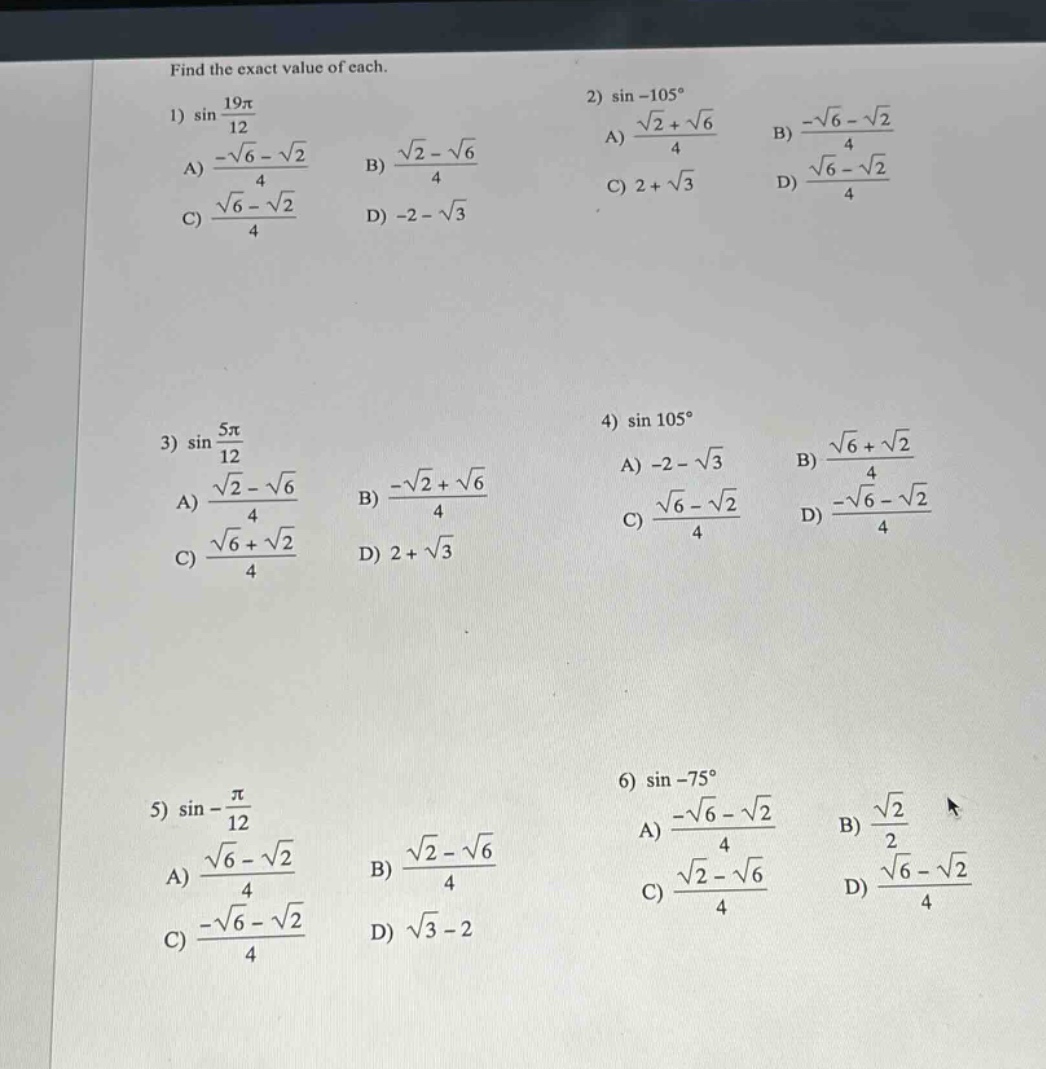
find the exact value of each. 1) sin(19π/12) a) (-√6 - √2)/4 b) (√2 - √6)/4 c) (√6 - √2)/4 d) -2 - √3 2) sin - 105° a) (√2 + √6)/4 b) (-√6 - √2)/4 c) 2 + √3 d) (√6 - √2)/4 3) sin(5π/12) a) (√2 - √6)/4 b) (-√2 + √6)/4 c) (√6 + √2)/4 d) 2 + √3 4) sin 105° a) -2 - √3 b) (√6 + √2)/4 c) (√6 - √2)/4 d) (-√6 - √2)/4 5) sin(-π/12) a) (√6 - √2)/4 b) (√2 - √6)/4 c) (-√6 - √2)/4 d) √3 - 2 6) sin - 75° a) (-√6 - √2)/4 b) √2/2 c) (√2 - √6)/4 d) (√6 - √2)/4
Answer
- For $\sin\frac{19\pi}{12}$:
- First, rewrite $\frac{19\pi}{12}$ as $\frac{19\pi}{12}=\frac{12\pi + 7\pi}{12}=\pi+\frac{7\pi}{12}$.
- Using the identity $\sin(A + B)=\sin A\cos B+\cos A\sin B$ and $\sin(\pi +\alpha)=-\sin\alpha$, we have $\sin\frac{19\pi}{12}=-\sin\frac{7\pi}{12}$.
- Since $\frac{7\pi}{12}=\frac{\pi}{3}+\frac{\pi}{4}$, then $\sin\frac{7\pi}{12}=\sin(\frac{\pi}{3}+\frac{\pi}{4})=\sin\frac{\pi}{3}\cos\frac{\pi}{4}+\cos\frac{\pi}{3}\sin\frac{\pi}{4}=\frac{\sqrt{3}}{2}\times\frac{\sqrt{2}}{2}+\frac{1}{2}\times\frac{\sqrt{2}}{2}=\frac{\sqrt{6}+\sqrt{2}}{4}$.
- So, $\sin\frac{19\pi}{12}=-\frac{\sqrt{6}+\sqrt{2}}{4}=\frac{-\sqrt{6}-\sqrt{2}}{4}$. The answer is A.
- For $\sin(- 105^{\circ})$:
- Using the property $\sin(-\alpha)=-\sin\alpha$, so $\sin(-105^{\circ})=-\sin105^{\circ}$.
- Since $105^{\circ}=60^{\circ}+45^{\circ}$, then $\sin105^{\circ}=\sin(60^{\circ}+45^{\circ})=\sin60^{\circ}\cos45^{\circ}+\cos60^{\circ}\sin45^{\circ}=\frac{\sqrt{3}}{2}\times\frac{\sqrt{2}}{2}+\frac{1}{2}\times\frac{\sqrt{2}}{2}=\frac{\sqrt{6}+\sqrt{2}}{4}$.
- So, $\sin(-105^{\circ})=-\frac{\sqrt{6}+\sqrt{2}}{4}=\frac{-\sqrt{6}-\sqrt{2}}{4}$. The answer is B.
- For $\sin\frac{5\pi}{12}$:
- Since $\frac{5\pi}{12}=\frac{\pi}{4}+\frac{\pi}{6}$, then $\sin\frac{5\pi}{12}=\sin(\frac{\pi}{4}+\frac{\pi}{6})=\sin\frac{\pi}{4}\cos\frac{\pi}{6}+\cos\frac{\pi}{4}\sin\frac{\pi}{6}=\frac{\sqrt{2}}{2}\times\frac{\sqrt{3}}{2}+\frac{\sqrt{2}}{2}\times\frac{1}{2}=\frac{\sqrt{6}+\sqrt{2}}{4}$. The answer is C.
- For $\sin105^{\circ}$:
- Since $105^{\circ}=60^{\circ}+45^{\circ}$, then $\sin105^{\circ}=\sin(60^{\circ}+45^{\circ})=\sin60^{\circ}\cos45^{\circ}+\cos60^{\circ}\sin45^{\circ}=\frac{\sqrt{3}}{2}\times\frac{\sqrt{2}}{2}+\frac{1}{2}\times\frac{\sqrt{2}}{2}=\frac{\sqrt{6}+\sqrt{2}}{4}$. The answer is B.
- For $\sin(-\frac{\pi}{12})$:
- Using the property $\sin(-\alpha)=-\sin\alpha$, so $\sin(-\frac{\pi}{12})=-\sin\frac{\pi}{12}$.
- Since $\frac{\pi}{12}=\frac{\pi}{3}-\frac{\pi}{4}$, then $\sin\frac{\pi}{12}=\sin(\frac{\pi}{3}-\frac{\pi}{4})=\sin\frac{\pi}{3}\cos\frac{\pi}{4}-\cos\frac{\pi}{3}\sin\frac{\pi}{4}=\frac{\sqrt{3}}{2}\times\frac{\sqrt{2}}{2}-\frac{1}{2}\times\frac{\sqrt{2}}{2}=\frac{\sqrt{6}-\sqrt{2}}{4}$.
- So, $\sin(-\frac{\pi}{12})=-\frac{\sqrt{6}-\sqrt{2}}{4}=\frac{-\sqrt{6}+\sqrt{2}}{4}=\frac{\sqrt{2}-\sqrt{6}}{4}$. The answer is B.
- For $\sin(-75^{\circ})$:
- Using the property $\sin(-\alpha)=-\sin\alpha$, so $\sin(-75^{\circ})=-\sin75^{\circ}$.
- Since $75^{\circ}=45^{\circ}+30^{\circ}$, then $\sin75^{\circ}=\sin(45^{\circ}+30^{\circ})=\sin45^{\circ}\cos30^{\circ}+\cos45^{\circ}\sin30^{\circ}=\frac{\sqrt{2}}{2}\times\frac{\sqrt{3}}{2}+\frac{\sqrt{2}}{2}\times\frac{1}{2}=\frac{\sqrt{6}+\sqrt{2}}{4}$.
- So, $\sin(-75^{\circ})=-\frac{\sqrt{6}+\sqrt{2}}{4}=\frac{-\sqrt{6}-\sqrt{2}}{4}$. The answer is A.
Answer:
- A. $\frac{-\sqrt{6}-\sqrt{2}}{4}$
- B. $\frac{-\sqrt{6}-\sqrt{2}}{4}$
- C. $\frac{\sqrt{6}+\sqrt{2}}{4}$
- B. $\frac{\sqrt{6}+\sqrt{2}}{4}$
- B. $\frac{\sqrt{2}-\sqrt{6}}{4}$
- A. $\frac{-\sqrt{6}-\sqrt{2}}{4}$
Explanation:
Step1: Rewrite angles
Express given - angles as sum or difference of known - angles.
Step2: Apply sum/difference formula
Use $\sin(A\pm B)=\sin A\cos B\pm\cos A\sin B$.
Step3: Substitute values
Substitute $\sin$ and $\cos$ values of special angles ($30^{\circ}=\frac{\pi}{6}$, $45^{\circ}=\frac{\pi}{4}$, $60^{\circ}=\frac{\pi}{3}$).
Step4: Simplify
Simplify the expressions to get the final results.