a. find the first four nonzero terms of the maclaurin series for the given function. b. write the power…
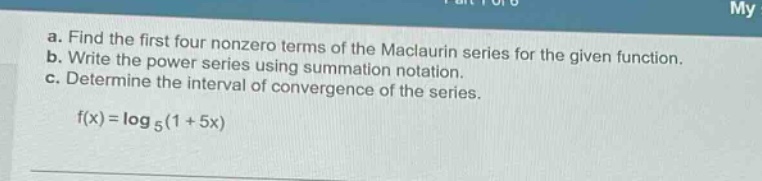
a. find the first four nonzero terms of the maclaurin series for the given function. b. write the power series using summation notation. c. determine the interval of convergence of the series. f(x)=log 5(1 + 5x)
Answer
Explanation:
Step1: Recall Maclaurin - series formula
The Maclaurin series of a function (f(x)) is given by (f(x)=\sum_{n = 0}^{\infty}\frac{f^{(n)}(0)}{n!}x^{n}), where (f^{(n)}(x)) is the (n) - th derivative of (f(x)). First, we know that (\log_{a}(u)=\frac{\ln(u)}{\ln(a)}), so (f(x)=\frac{\ln(1 + 5x)}{\ln(5)}). The Maclaurin series of (\ln(1 + t)=\sum_{n=1}^{\infty}\frac{(- 1)^{n + 1}}{n}t^{n}), for (|t|\lt1). Let (t = 5x).
Step2: Find the first four non - zero terms
Substitute (t = 5x) into the series for (\ln(1 + t)): [ \begin{align*} \ln(1+5x)&=\sum_{n = 1}^{\infty}\frac{(-1)^{n + 1}}{n}(5x)^{n}\ &=5x-\frac{(5x)^{2}}{2}+\frac{(5x)^{3}}{3}-\frac{(5x)^{4}}{4}+\cdots \end{align*} ] Then (f(x)=\frac{\ln(1 + 5x)}{\ln(5)}=\frac{1}{\ln(5)}\left(5x-\frac{25x^{2}}{2}+\frac{125x^{3}}{3}-\frac{625x^{4}}{4}+\cdots\right)). The first four non - zero terms are (\frac{5}{\ln(5)}x-\frac{25}{2\ln(5)}x^{2}+\frac{125}{3\ln(5)}x^{3}-\frac{625}{4\ln(5)}x^{4}).
Step3: Write the power series in summation notation
[f(x)=\frac{1}{\ln(5)}\sum_{n = 1}^{\infty}\frac{(-1)^{n + 1}5^{n}}{n}x^{n}]
Step4: Determine the interval of convergence
We know that the series for (\ln(1 + t)) converges for (|t|\lt1). Since (t = 5x), we set (|5x|\lt1). Solving for (x), we get (|x|\lt\frac{1}{5}), or (-\frac{1}{5}\lt x\lt\frac{1}{5}). We need to check the endpoints:
- When (x=\frac{1}{5}), the series becomes (\frac{1}{\ln(5)}\sum_{n = 1}^{\infty}\frac{(-1)^{n + 1}5^{n}}{n}\left(\frac{1}{5}\right)^{n}=\frac{1}{\ln(5)}\sum_{n = 1}^{\infty}\frac{(-1)^{n + 1}}{n}), which is the alternating harmonic series and converges.
- When (x=-\frac{1}{5}), the series becomes (\frac{1}{\ln(5)}\sum_{n = 1}^{\infty}\frac{(-1)^{n + 1}5^{n}}{n}\left(-\frac{1}{5}\right)^{n}=\frac{1}{\ln(5)}\sum_{n = 1}^{\infty}\frac{-1}{n}), which is the negative of the harmonic series and diverges.
So the interval of convergence is (\left(-\frac{1}{5},\frac{1}{5}\right]).
Answer:
a. (\frac{5}{\ln(5)}x-\frac{25}{2\ln(5)}x^{2}+\frac{125}{3\ln(5)}x^{3}-\frac{625}{4\ln(5)}x^{4}) b. (\frac{1}{\ln(5)}\sum_{n = 1}^{\infty}\frac{(-1)^{n + 1}5^{n}}{n}x^{n}) c. (\left(-\frac{1}{5},\frac{1}{5}\right])