find the following limit. if the limit does not exist, click on \does not exist.\ lim(x→3) (4 - √(19…
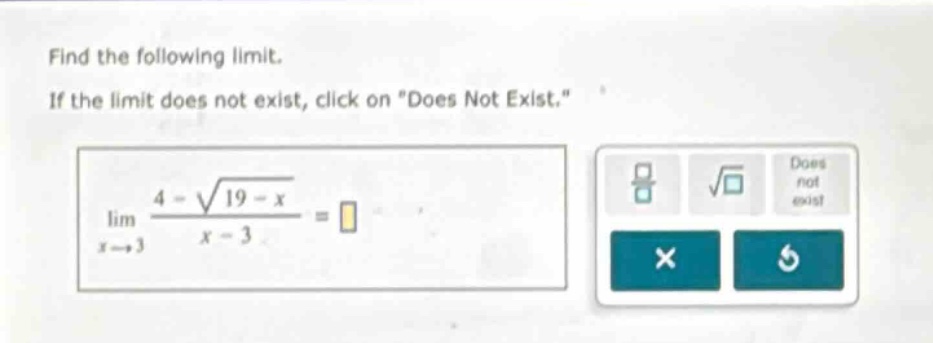
find the following limit. if the limit does not exist, click on \does not exist.\ lim(x→3) (4 - √(19 - x))/(x - 3) =
Answer
Explanation:
Step1: Rationalize the numerator
Multiply the fraction by $\frac{4 + \sqrt{19 - x}}{4+\sqrt{19 - x}}$. [ \begin{align*} &\lim_{x\rightarrow3}\frac{4-\sqrt{19 - x}}{x - 3}\times\frac{4+\sqrt{19 - x}}{4+\sqrt{19 - x}}\ =&\lim_{x\rightarrow3}\frac{16-(19 - x)}{(x - 3)(4+\sqrt{19 - x})}\ =&\lim_{x\rightarrow3}\frac{x - 3}{(x - 3)(4+\sqrt{19 - x})} \end{align*} ]
Step2: Simplify the fraction
Cancel out the common factor $(x - 3)$ in the numerator and denominator. [ \begin{align*} &\lim_{x\rightarrow3}\frac{x - 3}{(x - 3)(4+\sqrt{19 - x})}\ =&\lim_{x\rightarrow3}\frac{1}{4+\sqrt{19 - x}} \end{align*} ]
Step3: Evaluate the limit
Substitute $x = 3$ into the simplified - function. [ \begin{align*} &\frac{1}{4+\sqrt{19-3}}\ =&\frac{1}{4+\sqrt{16}}\ =&\frac{1}{4 + 4}\ =&\frac{1}{8} \end{align*} ]
Answer:
$\frac{1}{8}$