find the following limit. if the limit is infinite, enter infinity or -infinity. if the limit is not…
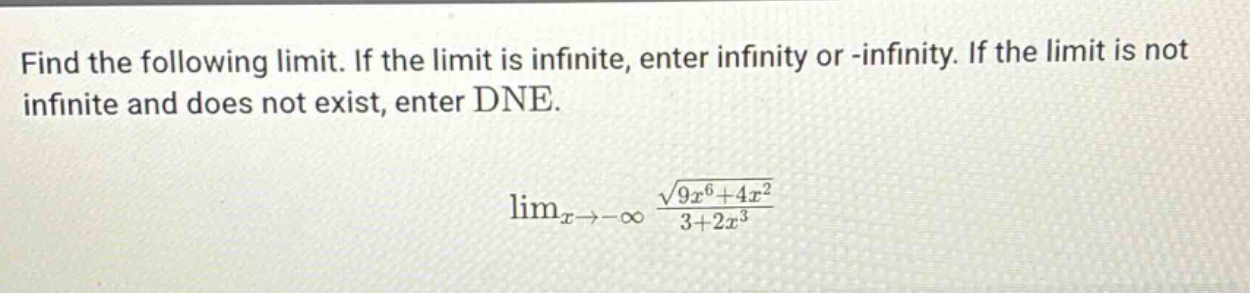
find the following limit. if the limit is infinite, enter infinity or -infinity. if the limit is not infinite and does not exist, enter dne. limx→−∞ √(9x^6 + 4x^2)/(3 + 2x^3)
Answer
Explanation:
Step1: Simplify the numerator
When (x\to-\infty), (\sqrt{9x^{6}+4x^{2}}=\sqrt{x^{6}(9 + \frac{4}{x^{4}})}=\vert x^{3}\vert\sqrt{9+\frac{4}{x^{4}}}). Since (x\to-\infty), (\vert x^{3}\vert=-x^{3}), so (\sqrt{9x^{6}+4x^{2}}=-x^{3}\sqrt{9+\frac{4}{x^{4}}}).
Step2: Rewrite the limit
The original limit (\lim_{x\to-\infty}\frac{\sqrt{9x^{6}+4x^{2}}}{3 + 2x^{3}}) becomes (\lim_{x\to-\infty}\frac{-x^{3}\sqrt{9+\frac{4}{x^{4}}}}{3 + 2x^{3}}).
Step3: Divide both numerator and denominator by (x^{3})
We get (\lim_{x\to-\infty}\frac{-\sqrt{9+\frac{4}{x^{4}}}}{\frac{3}{x^{3}}+2}).
Step4: Evaluate the limit
As (x\to-\infty), (\frac{4}{x^{4}}\to0) and (\frac{3}{x^{3}}\to0). So the limit is (\frac{-\sqrt{9 + 0}}{0+2}=\frac{-3}{2}).
Answer:
(-\frac{3}{2})