find the following limit. if the limit is infinite, enter infinity or -infinity. if the limit is not…
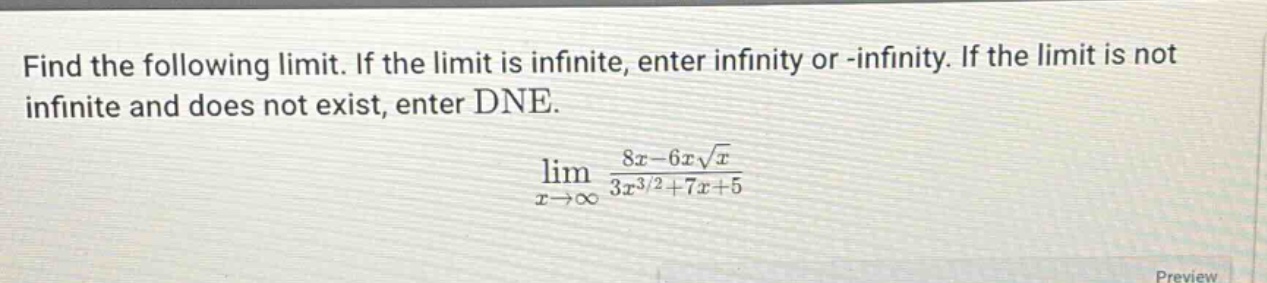
find the following limit. if the limit is infinite, enter infinity or -infinity. if the limit is not infinite and does not exist, enter dne. lim(x→∞) (8x - 6x√x)/(3x^(3/2)+7x + 5)
Answer
Explanation:
Step1: Divide by highest - power term
Divide both the numerator and denominator by $x^{3/2}$. The numerator $8x - 6x\sqrt{x}=8x - 6x^{3/2}$, and $\frac{8x - 6x^{3/2}}{x^{3/2}}=\frac{8x}{x^{3/2}}-\frac{6x^{3/2}}{x^{3/2}}=8x^{-1/2}-6$. The denominator $3x^{3/2}+7x + 5$, and $\frac{3x^{3/2}+7x + 5}{x^{3/2}}=3+\frac{7x}{x^{3/2}}+\frac{5}{x^{3/2}}=3 + 7x^{-1/2}+5x^{-3/2}$.
Step2: Evaluate limit as $x\to\infty$
We know that $\lim_{x\to\infty}x^{-n}=0$ for $n>0$. So, $\lim_{x\to\infty}(8x^{-1/2}-6)=0 - 6=-6$ and $\lim_{x\to\infty}(3 + 7x^{-1/2}+5x^{-3/2})=3+0 + 0=3$.
Step3: Find the overall limit
By the quotient - rule for limits $\lim_{x\to\infty}\frac{f(x)}{g(x)}=\frac{\lim_{x\to\infty}f(x)}{\lim_{x\to\infty}g(x)}$ (where $\lim_{x\to\infty}g(x)\neq0$), we have $\lim_{x\to\infty}\frac{8x - 6x\sqrt{x}}{3x^{3/2}+7x + 5}=\frac{\lim_{x\to\infty}(8x^{-1/2}-6)}{\lim_{x\to\infty}(3 + 7x^{-1/2}+5x^{-3/2})}=\frac{-6}{3}=-2$.
Answer:
$-2$