(b) find the following. use exact values and not decimal approximations. sin(4π/3)=□ sin(4π/3 + 2π)=□ (c)…
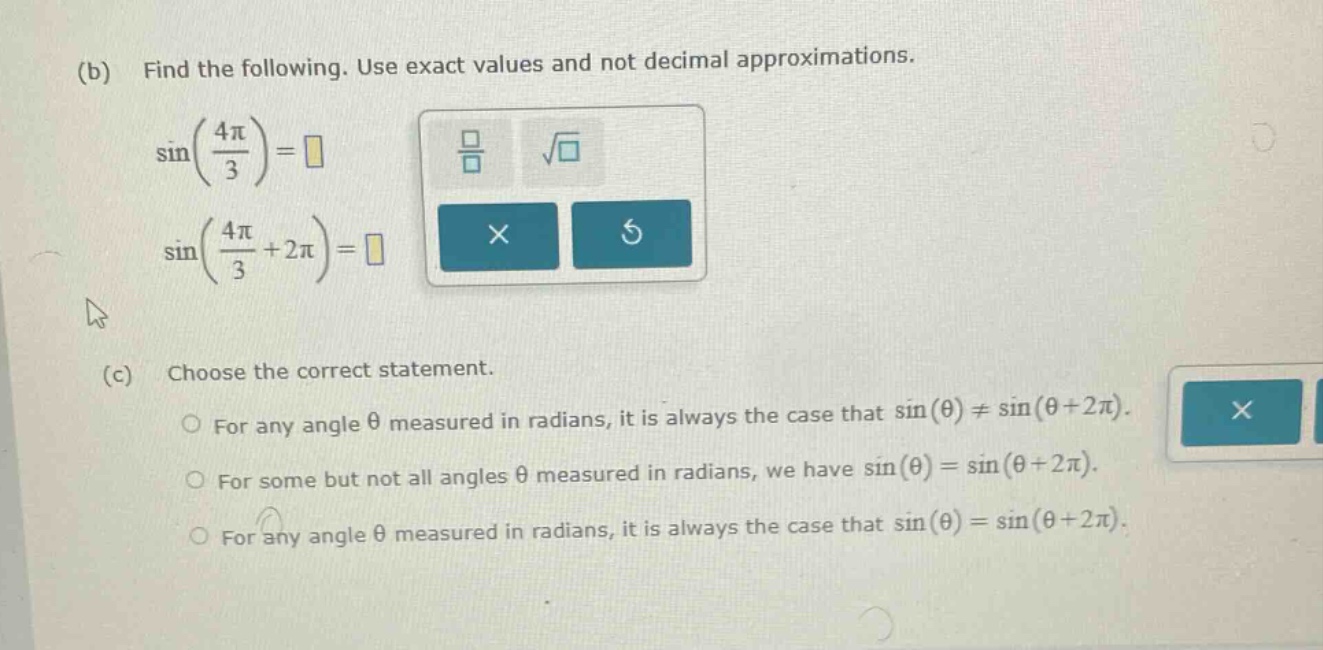
(b) find the following. use exact values and not decimal approximations. sin(4π/3)=□ sin(4π/3 + 2π)=□ (c) choose the correct statement. for any angle θ measured in radians, it is always the case that sin(θ)≠sin(θ + 2π). for some but not all angles θ measured in radians, we have sin(θ)=sin(θ + 2π). for any angle θ measured in radians, it is always the case that sin(θ)=sin(θ + 2π).
Answer
Explanation:
Step1: Rewrite $\frac{4\pi}{3}$
$\frac{4\pi}{3}=\pi+\frac{\pi}{3}$. Using the trig - identity $\sin(A + B)=\sin A\cos B+\cos A\sin B$, when $A = \pi$ and $B=\frac{\pi}{3}$, we know that $\sin(\pi+\alpha)=-\sin\alpha$. So $\sin(\frac{4\pi}{3})=\sin(\pi+\frac{\pi}{3})=-\sin\frac{\pi}{3}=-\frac{\sqrt{3}}{2}$.
Step2: Use the periodicity of the sine function
The sine function $y = \sin x$ has a period of $2\pi$, i.e., $\sin(x + 2\pi)=\sin x$ for all $x$. So $\sin(\frac{4\pi}{3}+2\pi)=\sin\frac{4\pi}{3}=-\frac{\sqrt{3}}{2}$.
Step3: Determine the correct statement about the periodicity of sine
The sine function is periodic with period $2\pi$. For any angle $\theta$ measured in radians, $\sin(\theta)=\sin(\theta + 2\pi)$.
Answer:
- $\sin(\frac{4\pi}{3})=-\frac{\sqrt{3}}{2}$
- $\sin(\frac{4\pi}{3}+2\pi)=-\frac{\sqrt{3}}{2}$
- For any angle $\theta$ measured in radians, it is always the case that $\sin(\theta)=\sin(\theta + 2\pi)$.