find a formula for this function.\ny = ? cos(\\frac{2\\pi}{ }(x - )) +
find a formula for this function.\ny = ? cos(\\frac{2\\pi}{ }(x - )) +
Answer
Explanation:
Step1: Find the amplitude
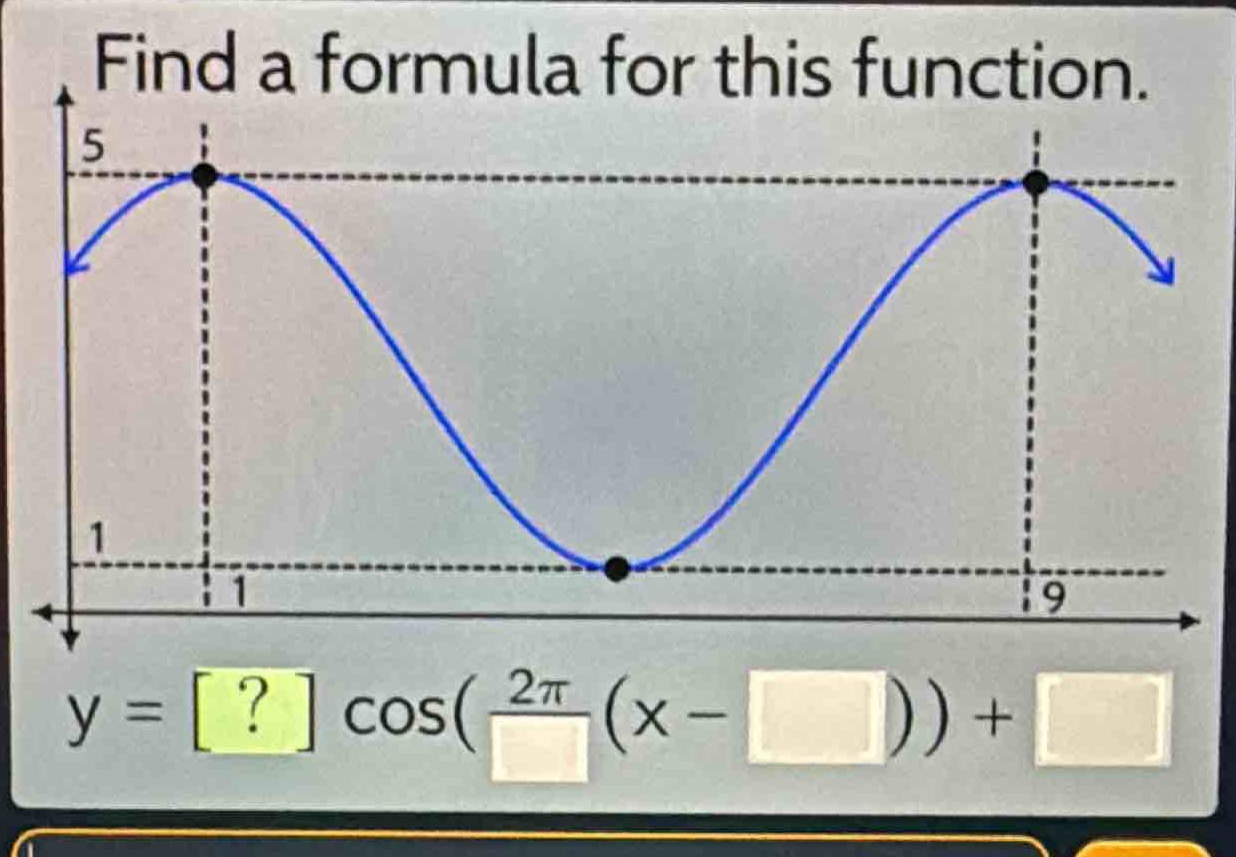
The amplitude $A$ of a cosine - function $y = A\cos(B(x - C))+D$ is given by $A=\frac{\text{max}-\text{min}}{2}$. Here, $\text{max} = 5$ and $\text{min}=1$. So, $A=\frac{5 - 1}{2}=2$.
Step2: Find the period and $B$
The period $T$ of the function is the horizontal distance between two consecutive maxima. Here, $T=9 - 1=8$. The formula for the period of a cosine - function is $T=\frac{2\pi}{B}$. Since $T = 8$, then $B=\frac{2\pi}{T}=\frac{2\pi}{8}=\frac{\pi}{4}$.
Step3: Find the phase - shift $C$
The cosine function $y = A\cos(B(x - C))+D$ has a maximum at $x = 1$. For the standard cosine function $y=\cos(x)$ which has a maximum at $x = 0$, the phase - shift $C$ is the value that makes $B(x - C)=0$ when $x = 1$. Since $B=\frac{\pi}{4}$, and $B(x - C)=0$ at the maximum, when $x = 1$, we have $\frac{\pi}{4}(1 - C)=0$, so $C = 1$.
Step4: Find the vertical shift $D$
The vertical shift $D$ of the cosine - function $y = A\cos(B(x - C))+D$ is given by $D=\frac{\text{max}+\text{min}}{2}$. So, $D=\frac{5 + 1}{2}=3$.
Answer:
$y = 2\cos\left(\frac{\pi}{4}(x - 1)\right)+3$