find $\frac{dy}{dx}$ for the given function.\n$y = x^{2}-csc(x)+1$\n$\frac{dy}{dx}=square$
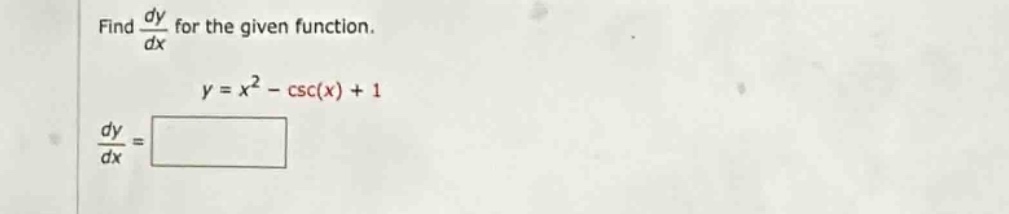
find $\frac{dy}{dx}$ for the given function.\n$y = x^{2}-csc(x)+1$\n$\frac{dy}{dx}=square$
Answer
Explanation:
Step1: Differentiate each term
Use sum - difference rule of differentiation $\frac{d}{dx}(u - v+w)=\frac{du}{dx}-\frac{dv}{dx}+\frac{dw}{dx}$. Here $u = x^{2}$, $v=\csc(x)$ and $w = 1$.
Step2: Differentiate $x^{2}$
By power rule $\frac{d}{dx}(x^{n})=nx^{n - 1}$, for $n = 2$, $\frac{d}{dx}(x^{2})=2x$.
Step3: Differentiate $\csc(x)$
The derivative of $\csc(x)$ is $-\csc(x)\cot(x)$.
Step4: Differentiate the constant
The derivative of a constant $C$ (here $C = 1$) is $0$, i.e., $\frac{d}{dx}(1)=0$.
Step5: Combine the derivatives
$\frac{dy}{dx}=\frac{d}{dx}(x^{2})-\frac{d}{dx}(\csc(x))+\frac{d}{dx}(1)$. Substitute the results of previous steps: $\frac{dy}{dx}=2x-(-\csc(x)\cot(x)) + 0$.
Answer:
$2x+\csc(x)\cot(x)$