find a function of the form y = a sin(kx) + c or y = a cos(kx) + c whose graph matches the function shown…
find a function of the form y = a sin(kx) + c or y = a cos(kx) + c whose graph matches the function shown below: leave your answer in exact form; if necessary, type pi for π. y = -5 cos(π/3 x) - 3 question help: video
Answer
Explanation:
Step1: Determine the vertical - shift C
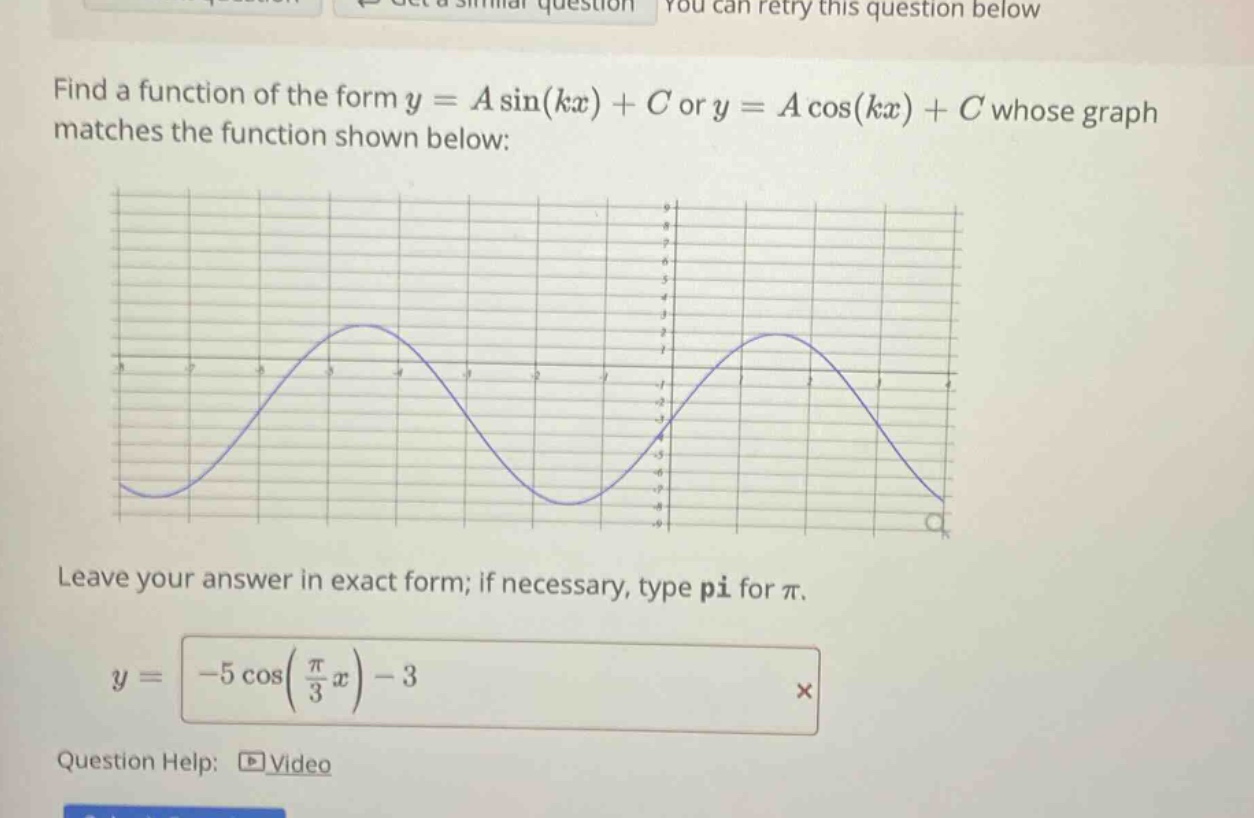
The mid - line of the cosine function is the average of the maximum and minimum values. The maximum value of the function from the graph is (y = 2) and the minimum value is (y=-8). So, (C=\frac{2+( - 8)}{2}=\frac{2 - 8}{2}=-3).
Step2: Determine the amplitude A
The amplitude (A) is the distance from the mid - line to the maximum or minimum value. (A=\vert2-( - 3)\vert=\vert2 + 3\vert = 5). Since the graph starts at the minimum value (a cosine function starts at the maximum when (A>0) and we start at the minimum here, so (A=-5)).
Step3: Determine the period and k
The period (T) of a cosine function (y = A\cos(kx)+C) is given by (T=\frac{2\pi}{k}). From the graph, the period (T = 6). So, (6=\frac{2\pi}{k}), and solving for (k) gives (k=\frac{\pi}{3}).
Answer:
(y=-5\cos\left(\frac{\pi}{3}x\right)-3)