find the function represented by the following series and find the interval of convergence of the series…
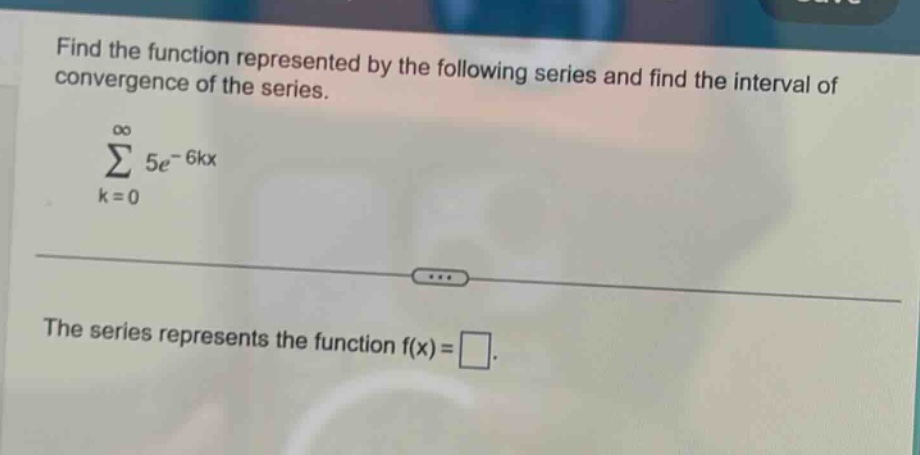
find the function represented by the following series and find the interval of convergence of the series. \n∑(k = 0 to ∞) 5e^(-6kx)\nthe series represents the function f(x) = □.
Answer
Explanation:
Step1: Recognize geometric - series form
A geometric series has the form $\sum_{k = 0}^{\infty}ar^{k}$, where $a$ is the first - term and $r$ is the common ratio. In the given series $\sum_{k = 0}^{\infty}5e^{-6kx}=5\sum_{k = 0}^{\infty}(e^{-6x})^{k}$, we have $a = 5$ and $r=e^{-6x}$.
Step2: Use the formula for the sum of an infinite geometric series
The sum of an infinite geometric series $\sum_{k = 0}^{\infty}ar^{k}=\frac{a}{1 - r}$ when $|r|\lt1$. Substituting $a = 5$ and $r = e^{-6x}$ into the formula, we get $f(x)=\frac{5}{1 - e^{-6x}}=\frac{5e^{6x}}{e^{6x}-1}$ for $|e^{-6x}|\lt1$.
Step3: Find the interval of convergence
We solve the inequality $|e^{-6x}|\lt1$. Since $e^{-6x}=\frac{1}{e^{6x}}\gt0$ for all real $x$, the inequality $e^{-6x}\lt1$ is equivalent to $\frac{1}{e^{6x}}\lt1$, or $e^{6x}\gt1$. Taking the natural logarithm of both sides, $\ln(e^{6x})\gt\ln(1)$. Since $\ln(e^{6x}) = 6x$ and $\ln(1)=0$, we have $6x\gt0$, so $x\gt0$.
Answer:
The series represents the function $f(x)=\frac{5e^{6x}}{e^{6x}-1}$, and the interval of convergence is $(0,\infty)$