find the most general antiderivative of the function.\n11) f(x)=1/2x² - 2x + 6\n13) f(x)=e¹\n15) f(t)=(3t⁴…
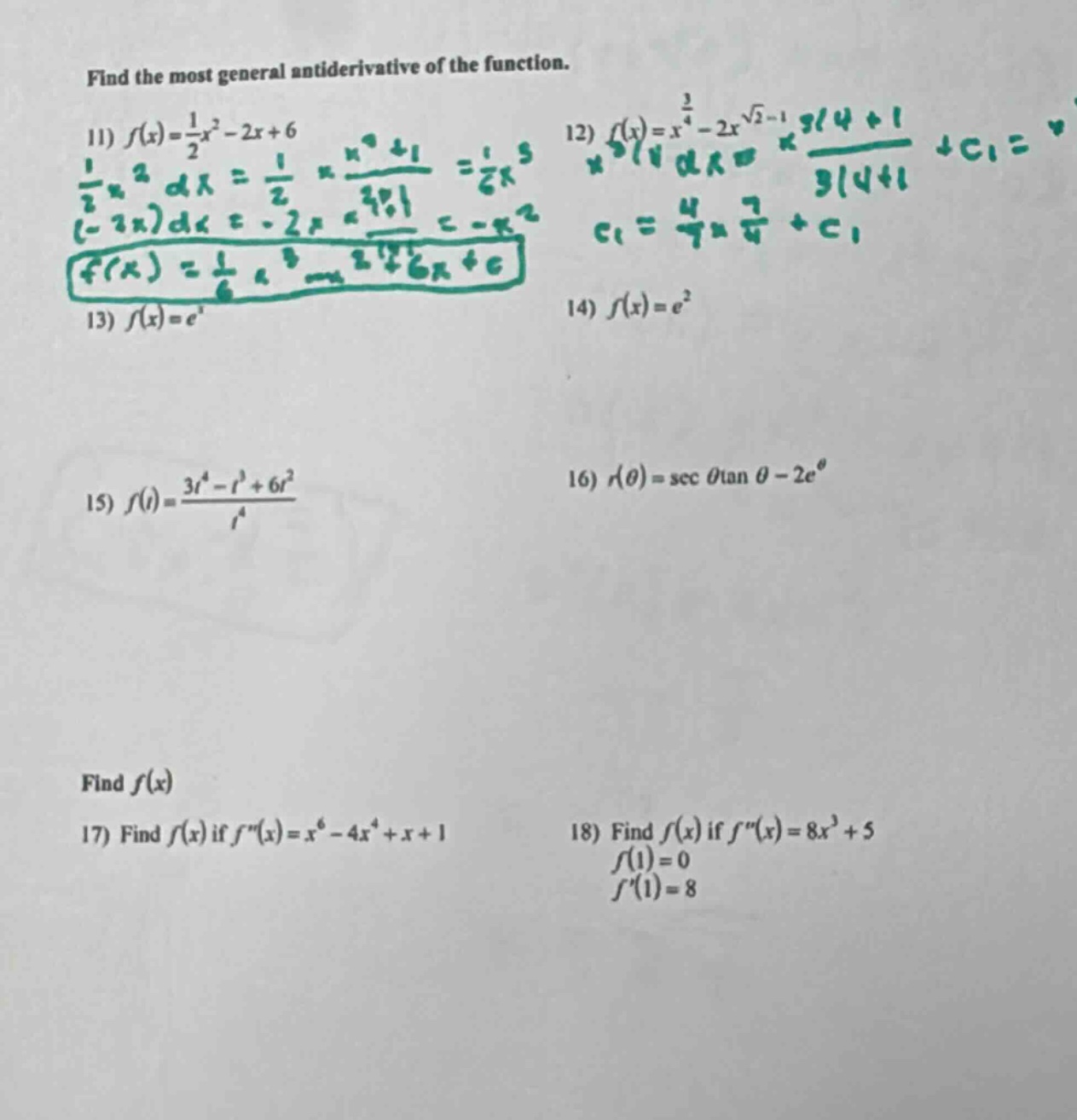
find the most general antiderivative of the function.\n11) f(x)=1/2x² - 2x + 6\n13) f(x)=e¹\n15) f(t)=(3t⁴ - t³ + 6t²)/t⁴\nfind f(x)\n17) find f(x) if f(x)=x⁶ - 4x⁴ + x + 1\n12) f(x)=x³/⁴ - 2x√2 - 1\n14) f(x)=e²\n16) r(θ)=sec θtan θ - 2e^θ\n18) find f(x) if f(x)=8x³ + 5\nf(1)=0\nf(1)=8
Answer
Explanation:
Step1: Recall antiderivative rules
The antiderivative of $x^n$ is $\frac{x^{n + 1}}{n+1}+C$ ($n\neq - 1$), the antiderivative of a constant $k$ is $kx + C$, and the antiderivative of $e^a$ (where $a$ is a constant) is $e^a x+C$.
Step2: Solve for $f(x)=\frac{1}{2}x^2-2x + 6$
The antiderivative $F(x)$ of $\frac{1}{2}x^2$ is $\frac{1}{2}\times\frac{x^{2 + 1}}{2+1}=\frac{1}{6}x^3$, the antiderivative of $-2x$ is $-2\times\frac{x^{1+1}}{1 + 1}=-x^2$, and the antiderivative of $6$ is $6x$. So $F(x)=\frac{1}{6}x^3-x^2 + 6x+C$.
Step3: Solve for $f(x)=e^2$
Since $e^2$ is a constant, its antiderivative is $e^2x + C$.
Step4: Solve for $f(t)=\frac{3t^4-t^3+6t^2}{t^4}=3 - \frac{1}{t}+6t^{-2}$
The antiderivative of $3$ is $3t$, the antiderivative of $-\frac{1}{t}$ is $-\ln|t|$, and the antiderivative of $6t^{-2}$ is $6\times\frac{t^{-2 + 1}}{-2+1}=- \frac{6}{t}$. So the antiderivative $F(t)=3t-\ln|t|-\frac{6}{t}+C$.
Step5: Solve for $r(\theta)=\sec\theta\tan\theta-2e^{\theta}$
The antiderivative of $\sec\theta\tan\theta$ is $\sec\theta$ and the antiderivative of $-2e^{\theta}$ is $-2e^{\theta}$. So the antiderivative $R(\theta)=\sec\theta-2e^{\theta}+C$.
Step6: Solve for $f''(x)=x^6-4x^4+x + 1$
First, find $f'(x)$ by integrating $f''(x)$. The antiderivative of $x^6$ is $\frac{x^{7}}{7}$, of $-4x^4$ is $-4\times\frac{x^{5}}{5}=-\frac{4x^{5}}{5}$, of $x$ is $\frac{x^{2}}{2}$, and of $1$ is $x$. So $f'(x)=\frac{1}{7}x^7-\frac{4}{5}x^5+\frac{1}{2}x^2+x + C_1$. Then integrate $f'(x)$ to get $f(x)=\frac{1}{56}x^8-\frac{2}{15}x^6+\frac{1}{6}x^3+\frac{1}{2}x^2+C_1x + C_2$.
Step7: Solve for $f''(x)=8x^3+5$
Integrate to get $f'(x)=8\times\frac{x^{4}}{4}+5x+C_1 = 2x^4+5x+C_1$. Since $f'(1) = 8$, then $2\times1^4+5\times1+C_1=8$, which gives $C_1=1$. So $f'(x)=2x^4+5x + 1$. Integrate again to get $f(x)=2\times\frac{x^{5}}{5}+5\times\frac{x^{2}}{2}+x+C_2=\frac{2}{5}x^5+\frac{5}{2}x^2+x+C_2$. Since $f(1) = 0$, then $\frac{2}{5}\times1^5+\frac{5}{2}\times1^2+1+C_2=0$, which gives $C_2=-\frac{4 + 25+10}{10}=-\frac{39}{10}$. So $f(x)=\frac{2}{5}x^5+\frac{5}{2}x^2+x-\frac{39}{10}$.
Answer:
- $\frac{1}{6}x^3-x^2 + 6x+C$
- $e^2x + C$
- $3t-\ln|t|-\frac{6}{t}+C$
- $\sec\theta-2e^{\theta}+C$
- $\frac{1}{56}x^8-\frac{2}{15}x^6+\frac{1}{6}x^3+\frac{1}{2}x^2+C_1x + C_2$
- $\frac{2}{5}x^5+\frac{5}{2}x^2+x-\frac{39}{10}$