find the most general antiderivative or indefinite integral. ∫(10/√x + 10√x) dx ∫(10/√x + 10√x) dx = □
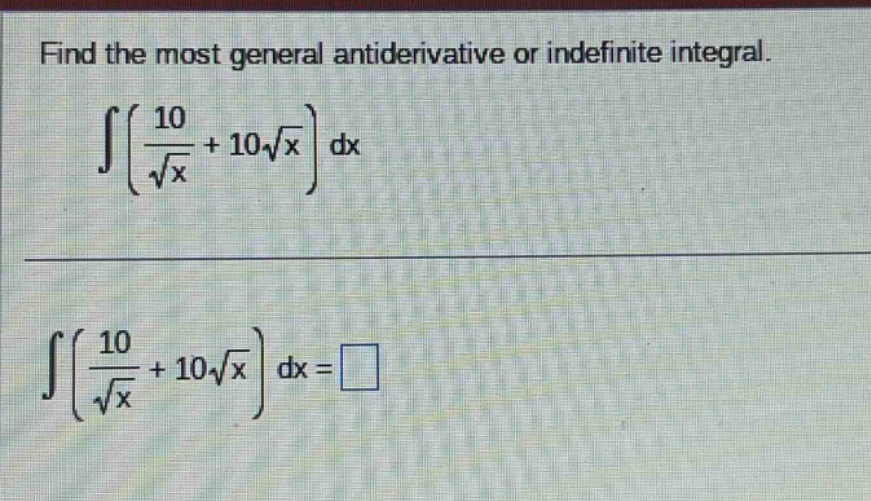
find the most general antiderivative or indefinite integral. ∫(10/√x + 10√x) dx ∫(10/√x + 10√x) dx = □
Answer
Explanation:
Step1: Rewrite the integrand
Rewrite $\frac{10}{\sqrt{x}}$ as $10x^{-\frac{1}{2}}$ and $10\sqrt{x}$ as $10x^{\frac{1}{2}}$. So the integral becomes $\int(10x^{-\frac{1}{2}} + 10x^{\frac{1}{2}})dx$.
Step2: Use the power - rule for integration
The power - rule for integration is $\int x^n dx=\frac{x^{n + 1}}{n+1}+C$ ($n\neq - 1$). For $\int10x^{-\frac{1}{2}}dx$, we have $10\times\frac{x^{-\frac{1}{2}+1}}{-\frac{1}{2}+1}=10\times\frac{x^{\frac{1}{2}}}{\frac{1}{2}} = 20x^{\frac{1}{2}}$. For $\int10x^{\frac{1}{2}}dx$, we have $10\times\frac{x^{\frac{1}{2}+1}}{\frac{1}{2}+1}=10\times\frac{x^{\frac{3}{2}}}{\frac{3}{2}}=\frac{20}{3}x^{\frac{3}{2}}$.
Step3: Combine the results
$\int(10x^{-\frac{1}{2}} + 10x^{\frac{1}{2}})dx=20x^{\frac{1}{2}}+\frac{20}{3}x^{\frac{3}{2}}+C$.
Answer:
$20\sqrt{x}+\frac{20}{3}x^{\frac{3}{2}}+C$