find the most general antiderivative or indefinite integral. ∫(1/x - 5/(4x² + 1)) dx ∫(1/x - 5/(4x² + 1)) dx…
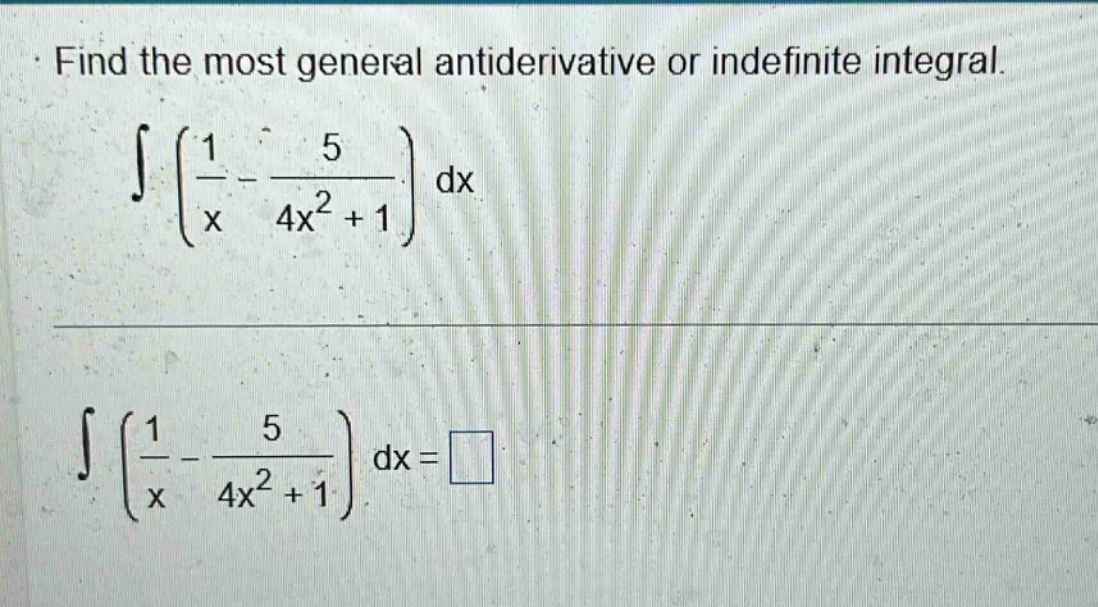
find the most general antiderivative or indefinite integral. ∫(1/x - 5/(4x² + 1)) dx ∫(1/x - 5/(4x² + 1)) dx = □
Answer
Explanation:
Step1: Split the integral
By the property $\int(f(x)-g(x))dx=\int f(x)dx-\int g(x)dx$, we have $\int\left(\frac{1}{x}-\frac{5}{4x^{2}+1}\right)dx=\int\frac{1}{x}dx - 5\int\frac{1}{4x^{2}+1}dx$.
Step2: Integrate $\int\frac{1}{x}dx$
The antiderivative of $\frac{1}{x}$ is $\ln|x|$, so $\int\frac{1}{x}dx=\ln|x|$.
Step3: Integrate $\int\frac{1}{4x^{2}+1}dx$
Let $u = 2x$, then $du=2dx$. So $\int\frac{1}{4x^{2}+1}dx=\frac{1}{2}\int\frac{1}{u^{2}+1}du$. The antiderivative of $\frac{1}{u^{2}+1}$ is $\arctan(u)$. Substituting back $u = 2x$, we get $\int\frac{1}{4x^{2}+1}dx=\frac{1}{2}\arctan(2x)$.
Step4: Combine the results
$5\int\frac{1}{4x^{2}+1}dx=\frac{5}{2}\arctan(2x)$. Then $\int\left(\frac{1}{x}-\frac{5}{4x^{2}+1}\right)dx=\ln|x|-\frac{5}{2}\arctan(2x)+C$.
Answer:
$\ln|x|-\frac{5}{2}\arctan(2x)+C$