find the most general antiderivative or indefinite integral. ∫(e^6x + 8e^-x) dx ∫(e^6x + 8e^-x) dx =
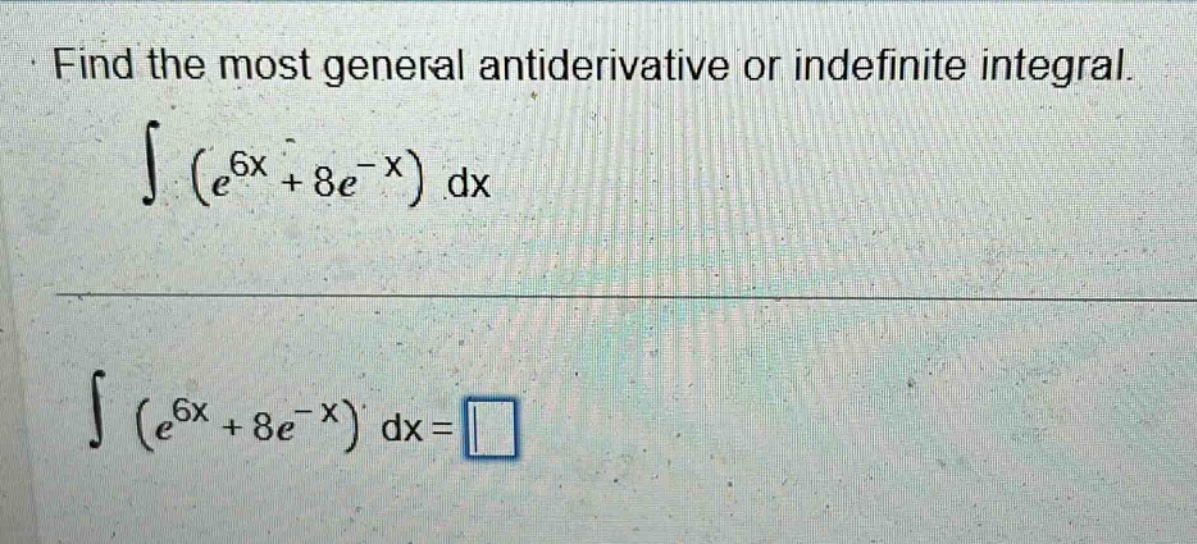
find the most general antiderivative or indefinite integral. ∫(e^6x + 8e^-x) dx ∫(e^6x + 8e^-x) dx =
Answer
Explanation:
Step1: Use integral sum - rule
$\int (e^{6x}+8e^{-x})dx=\int e^{6x}dx + 8\int e^{-x}dx$
Step2: Integrate $\int e^{6x}dx$
Let $u = 6x$, then $du=6dx$ and $\int e^{6x}dx=\frac{1}{6}\int e^{u}du=\frac{1}{6}e^{u}+C_1=\frac{1}{6}e^{6x}+C_1$
Step3: Integrate $\int e^{-x}dx$
Let $v=-x$, then $dv=-dx$ and $\int e^{-x}dx=-\int e^{v}dv=-e^{v}+C_2=-e^{-x}+C_2$
Step4: Combine the results
$\int e^{6x}dx + 8\int e^{-x}dx=\frac{1}{6}e^{6x}+8(-e^{-x})+C$ (where $C = C_1 + 8C_2$) $=\frac{1}{6}e^{6x}-8e^{-x}+C$
Answer:
$\frac{1}{6}e^{6x}-8e^{-x}+C$