find the most general antiderivative or indefinite integral. ∫(t∜(t⁵)+∜(t²))/t² dt ∫(t∜(t⁵)+∜(t²))/t² dt = □
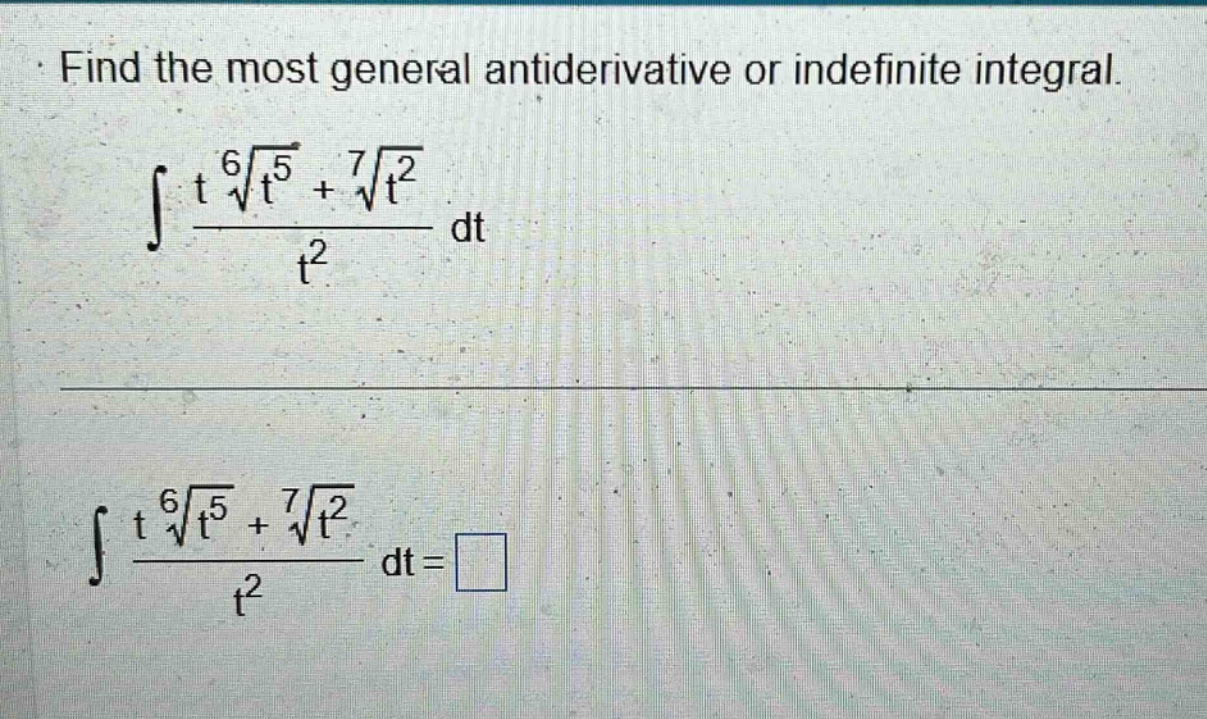
find the most general antiderivative or indefinite integral. ∫(t∜(t⁵)+∜(t²))/t² dt ∫(t∜(t⁵)+∜(t²))/t² dt = □
Answer
Explanation:
Step1: Rewrite the integrand using exponent - notation
First, rewrite $\sqrt[n]{x^m}=x^{\frac{m}{n}}$. So, $\sqrt[6]{t^{5}} = t^{\frac{5}{6}}$ and $\sqrt[7]{t^{2}}=t^{\frac{2}{7}}$. The integrand $\frac{t\sqrt[6]{t^{5}}+\sqrt[7]{t^{2}}}{t^{2}}$ becomes $\frac{t\cdot t^{\frac{5}{6}}+t^{\frac{2}{7}}}{t^{2}}$. Using the rule $a^m\cdot a^n=a^{m + n}$, we have $\frac{t^{1+\frac{5}{6}}+t^{\frac{2}{7}}}{t^{2}}=\frac{t^{\frac{6 + 5}{6}}+t^{\frac{2}{7}}}{t^{2}}=\frac{t^{\frac{11}{6}}+t^{\frac{2}{7}}}{t^{2}}$. Then, using the rule $\frac{a^m}{a^n}=a^{m - n}$, we get $t^{\frac{11}{6}-2}+t^{\frac{2}{7}-2}=t^{\frac{11 - 12}{6}}+t^{\frac{2-14}{7}}=t^{-\frac{1}{6}}+t^{-\frac{12}{7}}$.
Step2: Integrate term - by - term
The antiderivative of $t^n$ is $\frac{t^{n + 1}}{n+1}+C$ ($n\neq - 1$). For the first term $t^{-\frac{1}{6}}$, its antiderivative is $\frac{t^{-\frac{1}{6}+1}}{-\frac{1}{6}+1}=\frac{t^{\frac{5}{6}}}{\frac{5}{6}}=\frac{6}{5}t^{\frac{5}{6}}$. For the second term $t^{-\frac{12}{7}}$, its antiderivative is $\frac{t^{-\frac{12}{7}+1}}{-\frac{12}{7}+1}=\frac{t^{-\frac{5}{7}}}{-\frac{5}{7}}=-\frac{7}{5}t^{-\frac{5}{7}}$.
Answer:
$\frac{6}{5}t^{\frac{5}{6}}-\frac{7}{5}t^{-\frac{5}{7}}+C$