find the general solution of the following equation. express the solution explicitly as a function of the…
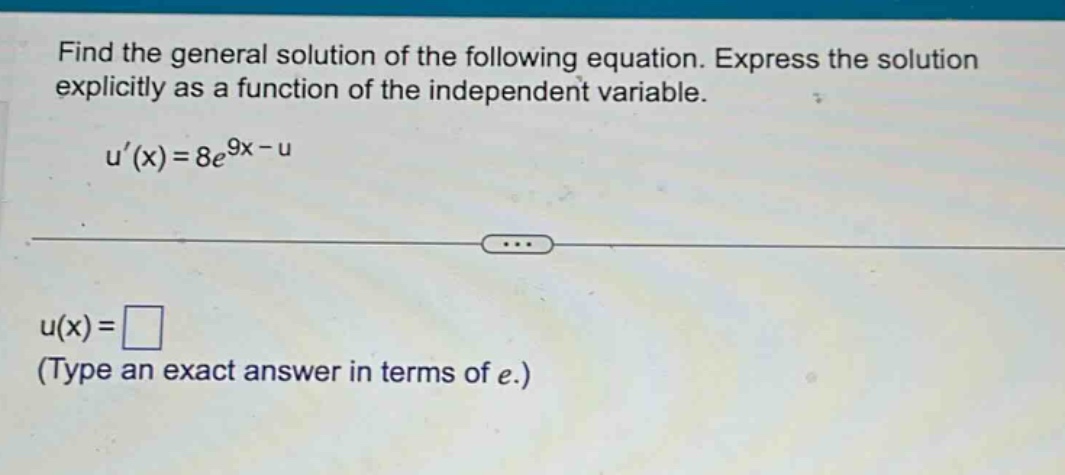
find the general solution of the following equation. express the solution explicitly as a function of the independent variable. u(x)=8e^9x - u u(x)= (type an exact answer in terms of e.)
Answer
Explanation:
Step1: Rewrite the ODE
The given first - order linear ordinary differential equation $u^{\prime}(x)=8e^{9x}-u$ can be rewritten in the standard form $u^{\prime}(x)+u = 8e^{9x}$. The integrating factor is $\mu(x)=e^{\int 1dx}=e^{x}$.
Step2: Multiply through by integrating factor
Multiply the entire equation $u^{\prime}(x)+u = 8e^{9x}$ by $e^{x}$: $e^{x}u^{\prime}(x)+e^{x}u = 8e^{10x}$. The left - hand side is the derivative of the product $e^{x}u$ by the product rule $(uv)^\prime = u^\prime v+uv^\prime$. So, $(e^{x}u)^\prime=8e^{10x}$.
Step3: Integrate both sides
Integrate both sides with respect to $x$: $\int(e^{x}u)^\prime dx=\int 8e^{10x}dx$. The left - hand side is $e^{x}u$, and for the right - hand side, $\int 8e^{10x}dx=8\times\frac{1}{10}e^{10x}+C=\frac{4}{5}e^{10x}+C$. So, $e^{x}u=\frac{4}{5}e^{10x}+C$.
Step4: Solve for $u(x)$
Divide both sides by $e^{x}$ to get $u(x)$: $u(x)=\frac{4}{5}e^{9x}+Ce^{-x}$.
Answer:
$u(x)=\frac{4}{5}e^{9x}+Ce^{-x}$