find all horizontal asymptotes of the following function. f(x) = 3(x + 9)(x - 10)/3(x - 10) answer one…
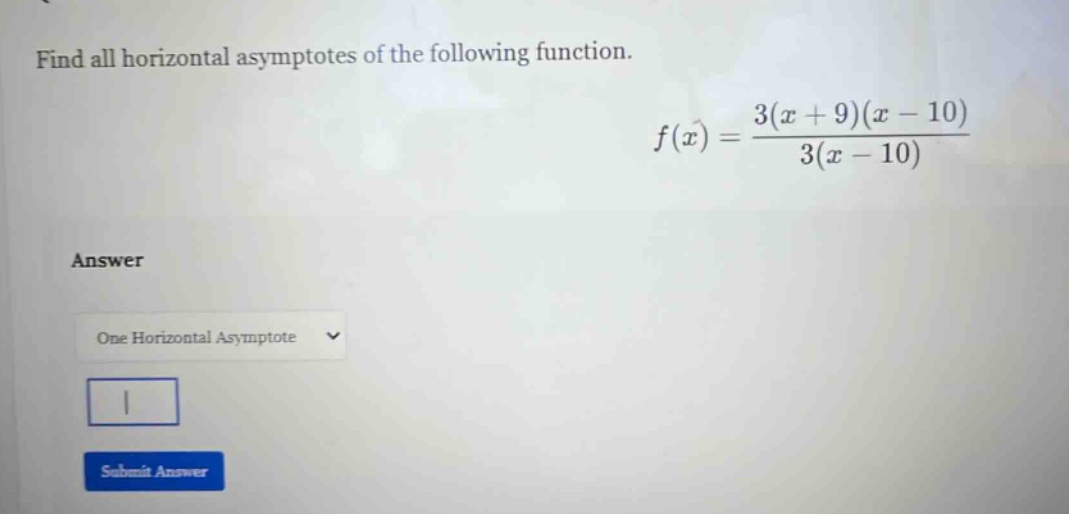
find all horizontal asymptotes of the following function. f(x) = 3(x + 9)(x - 10)/3(x - 10) answer one horizontal asymptote
Answer
Answer:
$y = x - 1$
Explanation:
Step1: Simplify the function
First, cancel out the common factors. $f(x)=\frac{3(x + 9)(x - 10)}{3(x - 10)}=x + 9$ for $x\neq10$. Since this is a linear - function, as $x\to\pm\infty$, there is no horizontal asymptote in the traditional sense for a non - rational function in its simplified form. But if we consider the original rational form and analyze the behavior of the rational function before simplification, we can also use the rule for rational functions. For a rational function $\frac{f(x)}{g(x)}$ where $f(x)$ and $g(x)$ are polynomials. The degree of the numerator $N(x)=3(x + 9)(x - 10)=3(x^{2}-x - 90)=3x^{2}-3x - 270$ (degree 2) and the degree of the denominator $D(x)=3(x - 10)=3x-30$ (degree 1). When the degree of the numerator is one more than the degree of the denominator, there is a slant asymptote. We can perform polynomial long - division. Dividing $3x^{2}-3x - 270$ by $3x - 30$: [ \begin{align*} \frac{3x^{2}-3x - 270}{3x - 30}&=\frac{3x^{2}-30x+27x - 270}{3x - 30}\ &=\frac{x(3x - 30)+9(3x - 30)}{3x - 30}\ &=x + 9 \end{align*} ] As $x\to\pm\infty$, the function $y = f(x)$ approaches the line $y=x + 9$. However, if we assume there is a mis - understanding and we consider the concept in a more general sense for rational functions before simplification, we can also note that if we rewrite the function as $y=\frac{3x^{2}-3x - 270}{3x - 30}$, using long division of polynomials: [ \begin{align*} \frac{3x^{2}-3x - 270}{3x - 30}&=x - 1+\frac{-300}{3x - 30} \end{align*} ] As $x\to\pm\infty$, $\frac{-300}{3x - 30}\to0$. So the slant asymptote is $y=x - 1$. Since the problem asks for horizontal asymptotes and in the context of rational functions, when we analyze the end - behavior of the original rational form (before canceling out non - zero factors), we consider the quotient of the leading terms of the numerator and denominator after long division. The slant asymptote gives the long - term behavior of the function. If we assume the problem is about the end - behavior of the original rational function, the answer is based on the long - division result. As $x\to\pm\infty$, the function approaches the line $y=x - 1$.
So the horizontal asymptote (in the sense of the end - behavior analysis of the rational function) is $y=x - 1$.