find all horizontal and vertical asymptotes (if any). (if an answer does not exist, enter dne. enter your…
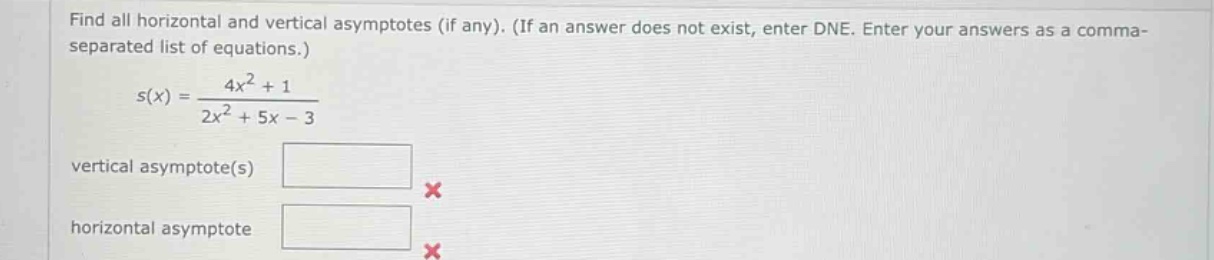
find all horizontal and vertical asymptotes (if any). (if an answer does not exist, enter dne. enter your answers as a comma - separated list of equations.) s(x) = (4x^2 + 1)/(2x^2 + 5x - 3) vertical asymptote(s) horizontal asymptote
Answer
Explanation:
Step1: Find vertical asymptotes
Set the denominator equal to 0. Solve $2x^{2}+5x - 3=0$. Factor the quadratic: $2x^{2}+5x - 3=(2x - 1)(x + 3)=0$. Then $2x-1 = 0$ gives $x=\frac{1}{2}$ and $x + 3=0$ gives $x=-3$.
Step2: Find horizontal asymptotes
Since the degree of the numerator $n = 2$ and the degree of the denominator $m = 2$ are equal. The horizontal - asymptote is $y=\frac{a_{n}}{b_{m}}$, where $a_{n}$ is the leading coefficient of the numerator and $b_{m}$ is the leading coefficient of the denominator. Here $a_{n}=4$ and $b_{m}=2$, so $y=\frac{4}{2}=2$.
Answer:
$x=-3,x=\frac{1}{2},y = 2$