find an integral expression equal to lim(n→∞) σ(k = 1 to n) ((-2/k + 3)+1)/(-2/n).
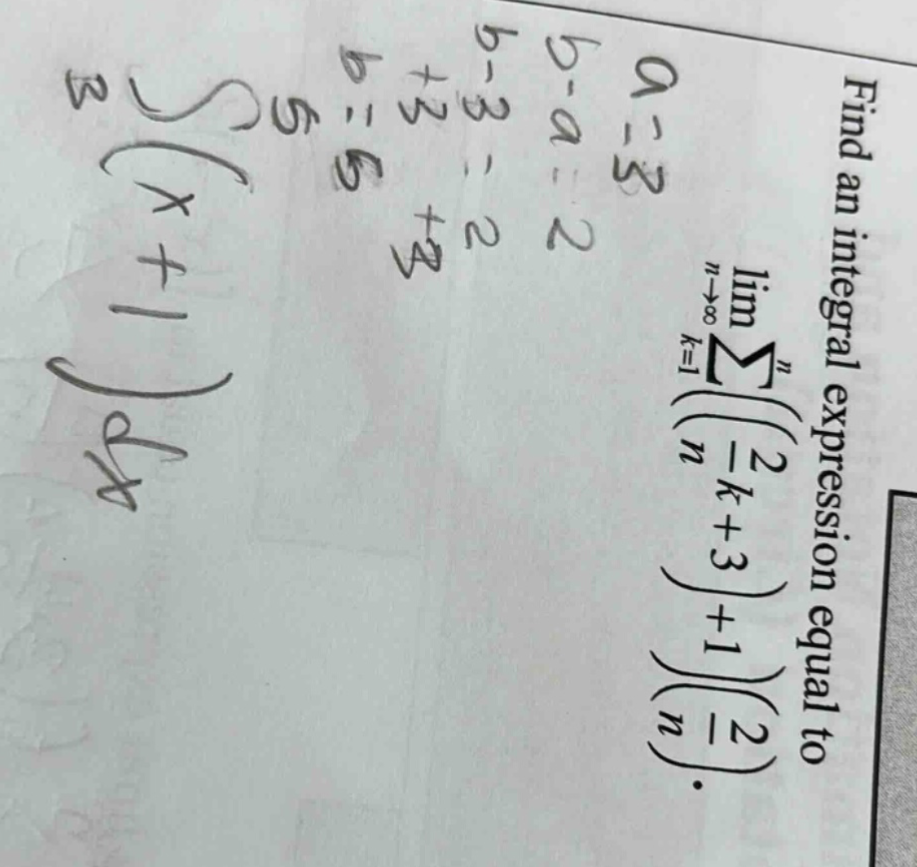
find an integral expression equal to lim(n→∞) σ(k = 1 to n) ((-2/k + 3)+1)/(-2/n).
Answer
Explanation:
Step1: Rewrite the sum as a Riemann - sum
We know that a Riemann - sum for the integral $\int_{a}^{b}f(x)dx=\lim_{n\rightarrow\infty}\sum_{k = 1}^{n}f(x_k)\Delta x$, where $\Delta x=\frac{b - a}{n}$ and $x_k=a + k\Delta x$. First, rewrite the given sum $\lim_{n\rightarrow\infty}\sum_{k = 1}^{n}\left(\frac{-2k+3}{n}+1\right)\frac{2}{n}$. Let $x_k=\frac{k}{n}$, then $\Delta x=\frac{2}{n}$, so $b - a = 2$. And $\frac{-2k + 3}{n}+1=-2\frac{k}{n}+\frac{3}{n}+1$. As $n\rightarrow\infty$, $\frac{3}{n}\rightarrow0$. So the function $f(x)=-2x + 1$. Also, when $k = 1$, $x_1=\frac{1}{n}$, and when $k=n$, $x_n = 1$. Since $\Delta x=\frac{2}{n}$, we can assume $a = 0$ and $b = 2$.
Step2: Write the integral
The integral corresponding to the given limit of the sum is $\int_{0}^{2}(-2x + 1)dx$.
Step3: Evaluate the integral
Using the power - rule for integration $\int x^n dx=\frac{x^{n + 1}}{n+1}+C(n\neq - 1)$, we have: [ \begin{align*} \int_{0}^{2}(-2x + 1)dx&=\int_{0}^{2}-2xdx+\int_{0}^{2}1dx\ &=-2\int_{0}^{2}xdx+\int_{0}^{2}1dx\ &=-2\times\left[\frac{x^{2}}{2}\right]{0}^{2}+[x]{0}^{2}\ &=-(2^{2}-0^{2})+(2 - 0)\ &=-4 + 2\ &=-2 \end{align*} ]
Answer:
$-2$