find intervals where this function is increasing, decreasing, or constant. f(x)=x^{3}-x^{2}-2x decreasing…
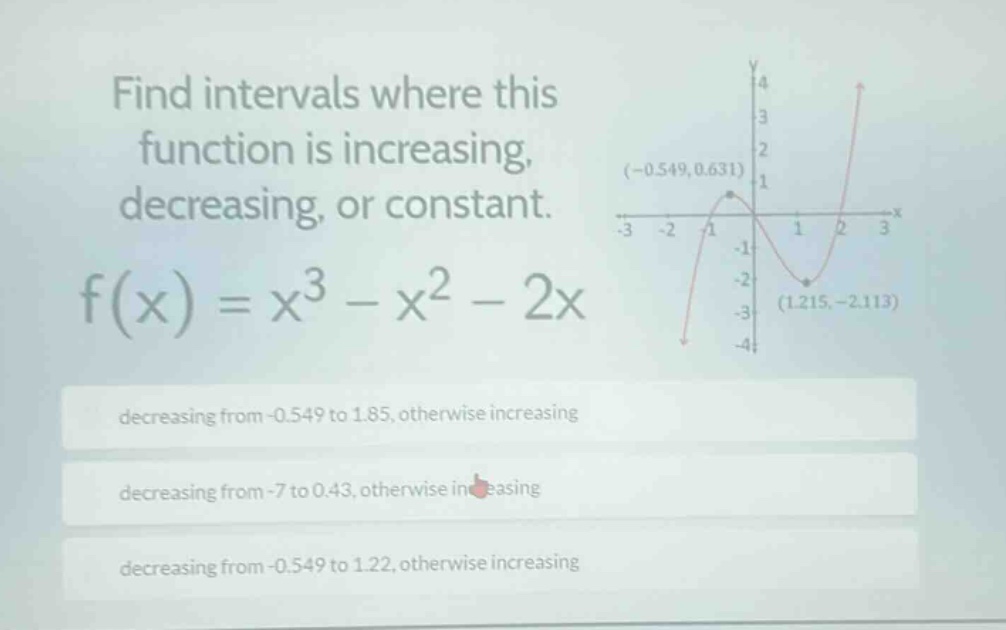
find intervals where this function is increasing, decreasing, or constant. f(x)=x^{3}-x^{2}-2x decreasing from -0.549 to 1.85, otherwise increasing decreasing from -7 to 0.43, otherwise increasing decreasing from -0.549 to 1.22, otherwise increasing
Answer
Explanation:
Step1: Find the derivative
Differentiate $f(x)=x^{3}-x^{2}-2x$ using the power - rule. The derivative $f^\prime(x)=3x^{2}-2x - 2$.
Step2: Find the critical points
Set $f^\prime(x) = 0$. Using the quadratic formula $x=\frac{-b\pm\sqrt{b^{2}-4ac}}{2a}$ for the quadratic equation $3x^{2}-2x - 2=0$, where $a = 3$, $b=-2$, and $c=-2$. Then $x=\frac{2\pm\sqrt{(-2)^{2}-4\times3\times(-2)}}{2\times3}=\frac{2\pm\sqrt{4 + 24}}{6}=\frac{2\pm\sqrt{28}}{6}=\frac{2\pm2\sqrt{7}}{6}=\frac{1\pm\sqrt{7}}{3}$. $x_1=\frac{1+\sqrt{7}}{3}\approx1.22$ and $x_2=\frac{1 - \sqrt{7}}{3}\approx - 0.549$.
Step3: Test the intervals
Choose test points in the intervals $(-\infty,\frac{1 - \sqrt{7}}{3})$, $(\frac{1 - \sqrt{7}}{3},\frac{1+\sqrt{7}}{3})$, and $(\frac{1+\sqrt{7}}{3},\infty)$. For the interval $(-\infty,\frac{1 - \sqrt{7}}{3})$, let $x=-1$. Then $f^\prime(-1)=3+2 - 2 = 3>0$, so the function is increasing. For the interval $(\frac{1 - \sqrt{7}}{3},\frac{1+\sqrt{7}}{3})$, let $x = 0$. Then $f^\prime(0)=-2<0$, so the function is decreasing. For the interval $(\frac{1+\sqrt{7}}{3},\infty)$, let $x = 2$. Then $f^\prime(2)=12-4 - 2 = 6>0$, so the function is increasing.
Answer:
decreasing from -0.549 to 1.22, otherwise increasing