find the intervals on which the graph of f is concave upward, the intervals on which the graph of f is…
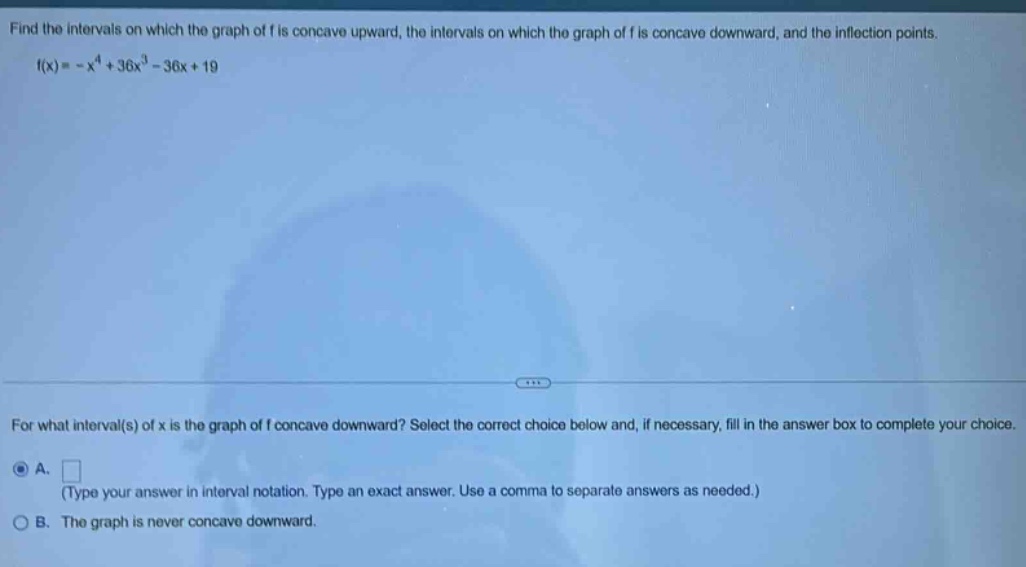
find the intervals on which the graph of f is concave upward, the intervals on which the graph of f is concave downward, and the inflection points. f(x)= -x^4 + 36x^3 - 36x + 19 for what interval(s) of x is the graph of f concave downward? select the correct choice below and, if necessary, fill in the answer box to complete your choice. a. (type your answer in interval notation. type an exact answer. use a comma to separate answers as needed.) b. the graph is never concave downward.
Answer
Explanation:
Step1: Find the first - derivative
Using the power rule $\frac{d}{dx}(x^n)=nx^{n - 1}$, for $f(x)=-x^{4}+36x^{3}-36x + 19$, we have $f'(x)=-4x^{3}+108x^{2}-36$.
Step2: Find the second - derivative
Differentiate $f'(x)$ again. $f''(x)=-12x^{2}+216x$.
Step3: Set $f''(x) = 0$ to find potential inflection points
$-12x^{2}+216x = 0$. Factor out $-12x$: $-12x(x - 18)=0$. So $x = 0$ and $x = 18$ are potential inflection points.
Step4: Test intervals for concavity
Choose test points in the intervals $(-\infty,0)$, $(0,18)$ and $(18,\infty)$. For the interval $(-\infty,0)$, let $x=-1$. Then $f''(-1)=-12\times(-1)^{2}+216\times(-1)=-12 - 216=-228<0$. For the interval $(0,18)$, let $x = 1$. Then $f''(1)=-12\times1^{2}+216\times1=-12 + 216 = 204>0$. For the interval $(18,\infty)$, let $x = 19$. Then $f''(19)=-12\times19^{2}+216\times19=-12\times361+4104=-4332 + 4104=-228<0$.
The graph is concave downward on the intervals $(-\infty,0)\cup(18,\infty)$.
Answer:
$(-\infty,0),(18,\infty)$