find the intervals on which the graph of f is concave upward, the intervals on which the graph of f is…
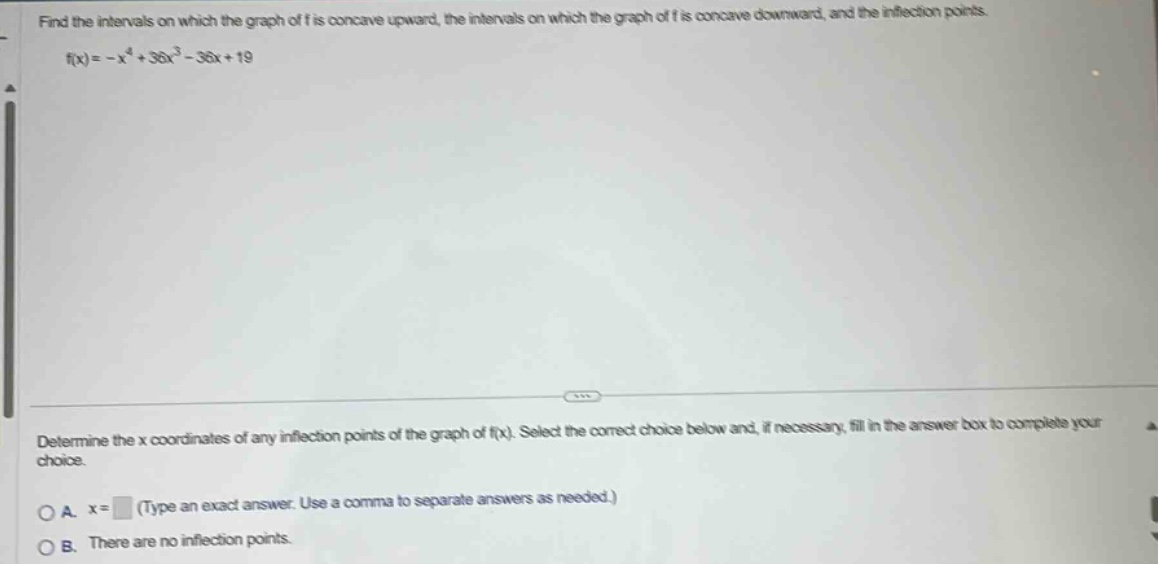
find the intervals on which the graph of f is concave upward, the intervals on which the graph of f is concave downward, and the inflection points. f(x)= -x^4 + 36x^3 - 36x + 19 determine the x coordinates of any inflection points of the graph of f(x). select the correct choice below and, if necessary, fill in the answer box to complete your choice. a. x= (type an exact answer. use a comma to separate answers as needed.) b. there are no inflection points.
Answer
Explanation:
Step1: Find the first - derivative
Using the power rule $\frac{d}{dx}(x^n)=nx^{n - 1}$, for $f(x)=-x^{4}+36x^{3}-36x + 19$, we have $f'(x)=-4x^{3}+108x^{2}-36$.
Step2: Find the second - derivative
Differentiate $f'(x)$ again. $f''(x)=-12x^{2}+216x$.
Step3: Set the second - derivative equal to zero
Solve $f''(x)=0$, so $-12x^{2}+216x = 0$. Factor out $-12x$: $-12x(x - 18)=0$. Then $x = 0$ or $x = 18$.
Step4: Test the intervals
Choose test points in the intervals $(-\infty,0)$, $(0,18)$ and $(18,\infty)$. For the interval $(-\infty,0)$, let $x=-1$. Then $f''(-1)=-12\times(-1)^{2}+216\times(-1)=-12 - 216=-228<0$, so the graph is concave downward on $(-\infty,0)$. For the interval $(0,18)$, let $x = 1$. Then $f''(1)=-12\times1^{2}+216\times1=-12 + 216 = 204>0$, so the graph is concave upward on $(0,18)$. For the interval $(18,\infty)$, let $x = 19$. Then $f''(19)=-12\times19^{2}+216\times19=-12\times361+4104=-4332 + 4104=-228<0$, so the graph is concave downward on $(18,\infty)$.
Answer:
The graph of $f(x)$ is concave upward on the interval $(0,18)$, concave downward on the intervals $(-\infty,0)$ and $(18,\infty)$. The $x$ - coordinates of the inflection points are $x = 0,18$. So the answer is A. $x = 0,18$