find the intervals on which f is increasing and decreasing. f(x)=2x^4 - 2x^2 + 15 select the correct choice…
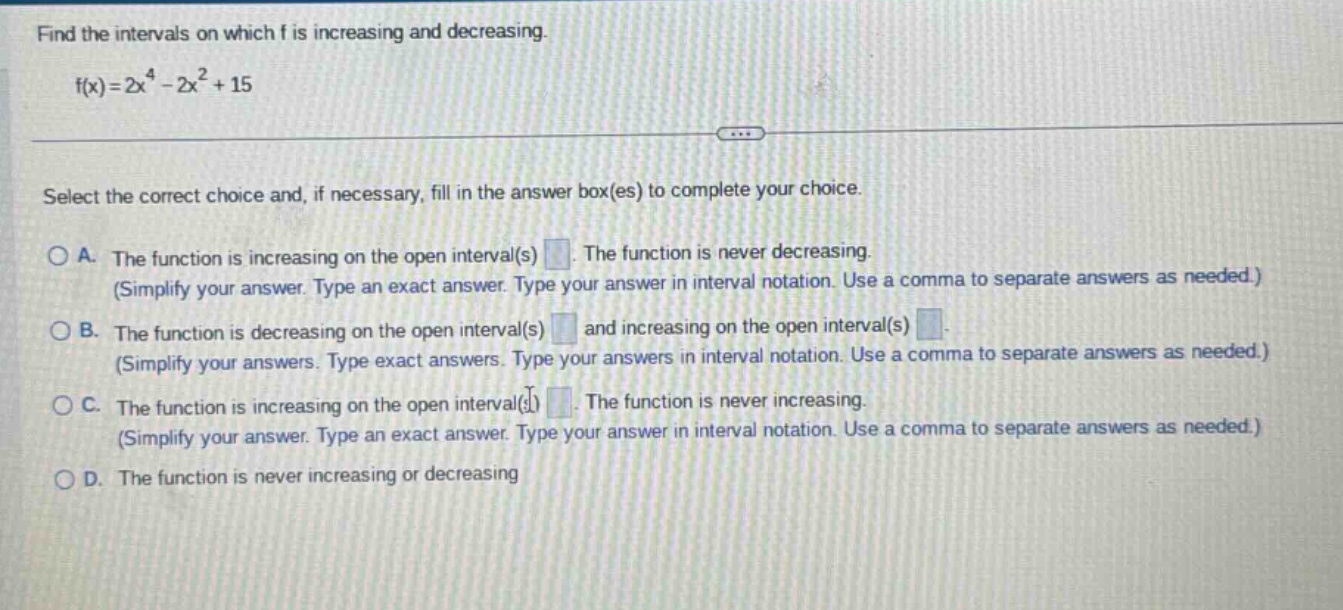
find the intervals on which f is increasing and decreasing. f(x)=2x^4 - 2x^2 + 15 select the correct choice and, if necessary, fill in the answer box(es) to complete your choice. a. the function is increasing on the open interval(s) . the function is never decreasing. (simplify your answer. type an exact answer. type your answer in interval notation. use a comma to separate answers as needed.) b. the function is decreasing on the open interval(s) and increasing on the open interval(s) . (simplify your answers. type exact answers. type your answers in interval notation. use a comma to separate answers as needed.) c. the function is increasing on the open interval(s) . the function is never increasing. (simplify your answer. type an exact answer. type your answer in interval notation. use a comma to separate answers as needed.) d. the function is never increasing or decreasing
Answer
Explanation:
Step1: Find the derivative
Differentiate $f(x)=2x^{4}-2x^{2}+15$ using power - rule. $f^\prime(x)=8x^{3}-4x = 4x(2x^{2}-1)$.
Step2: Find the critical points
Set $f^\prime(x)=0$. So $4x(2x^{2}-1)=0$. Then $4x = 0$ gives $x = 0$, and $2x^{2}-1=0$ gives $x=\pm\frac{1}{\sqrt{2}}$.
Step3: Test the intervals
Consider the intervals $(-\infty,-\frac{1}{\sqrt{2}})$, $(-\frac{1}{\sqrt{2}},0)$, $(0,\frac{1}{\sqrt{2}})$ and $(\frac{1}{\sqrt{2}},\infty)$. For $x\in(-\infty,-\frac{1}{\sqrt{2}})$, let $x=-1$, then $f^\prime(-1)=4\times(-1)\times(2\times(-1)^{2}-1)= - 4<0$, so $f(x)$ is decreasing. For $x\in(-\frac{1}{\sqrt{2}},0)$, let $x =-\frac{1}{2}$, then $f^\prime(-\frac{1}{2})=4\times(-\frac{1}{2})\times(2\times(-\frac{1}{2})^{2}-1)=1>0$, so $f(x)$ is increasing. For $x\in(0,\frac{1}{\sqrt{2}})$, let $x=\frac{1}{2}$, then $f^\prime(\frac{1}{2})=4\times\frac{1}{2}\times(2\times(\frac{1}{2})^{2}-1)= - 1<0$, so $f(x)$ is decreasing. For $x\in(\frac{1}{\sqrt{2}},\infty)$, let $x = 1$, then $f^\prime(1)=4\times1\times(2\times1^{2}-1)=4>0$, so $f(x)$ is increasing.
Answer:
B. The function is decreasing on the open intervals $(-\infty,-\frac{1}{\sqrt{2}}),(0,\frac{1}{\sqrt{2}})$ and increasing on the open intervals $(-\frac{1}{\sqrt{2}},0),(\frac{1}{\sqrt{2}},\infty)$