find the intervals on which f is increasing and the intervals on which it is decreasing. f(x)= - 6 - x +…
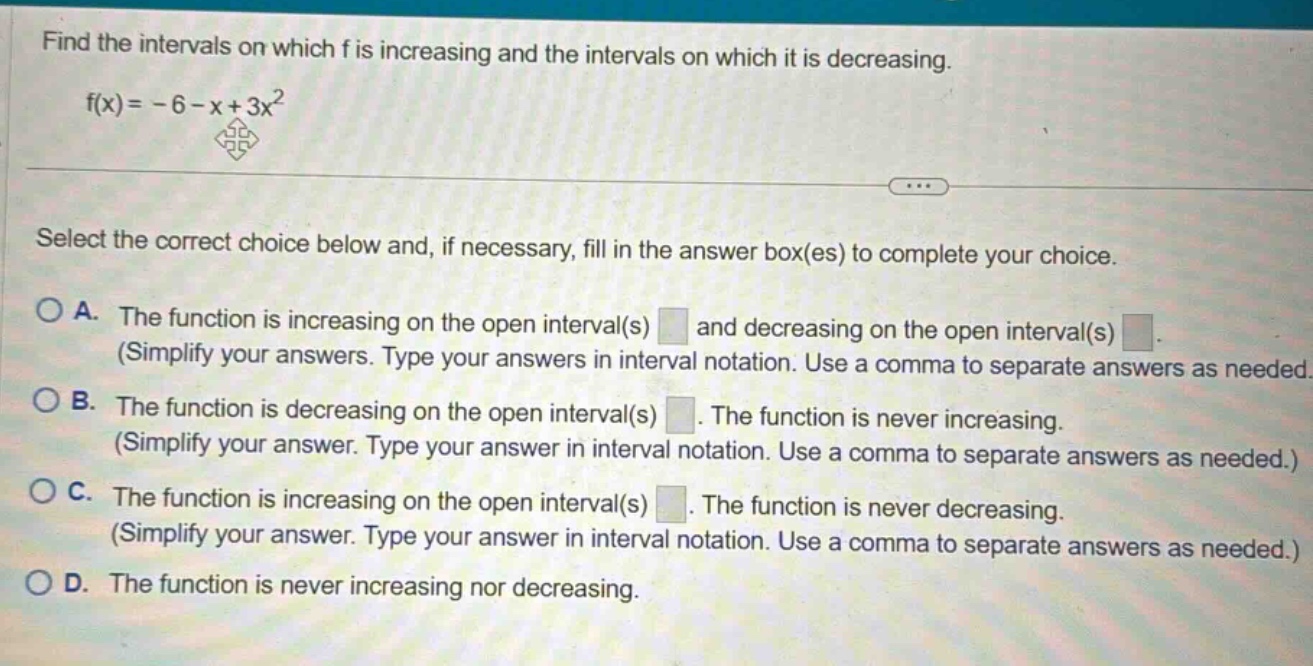
find the intervals on which f is increasing and the intervals on which it is decreasing. f(x)= - 6 - x + 3x^2 select the correct choice below and, if necessary, fill in the answer box(es) to complete your choice. o a. the function is increasing on the open interval(s) and decreasing on the open interval(s) (simplify your answers. type your answers in interval notation. use a comma to separate answers as needed. o b. the function is decreasing on the open interval(s). the function is never increasing. (simplify your answer. type your answer in interval notation. use a comma to separate answers as needed.) o c. the function is increasing on the open interval(s). the function is never decreasing. (simplify your answer. type your answer in interval notation. use a comma to separate answers as needed.) o d. the function is never increasing nor decreasing.
Answer
Explanation:
Step1: Find the derivative
Differentiate $f(x)=-6 - x+3x^{2}$ using power - rule. The derivative $f^\prime(x)=\frac{d}{dx}(-6)-\frac{d}{dx}(x)+\frac{d}{dx}(3x^{2})$. Since $\frac{d}{dx}(c) = 0$ for a constant $c$, $\frac{d}{dx}(x)=1$ and $\frac{d}{dx}(ax^{n})=nax^{n - 1}$, we have $f^\prime(x)=-1 + 6x$.
Step2: Find the critical points
Set $f^\prime(x)=0$. So, $-1 + 6x=0$. Solving for $x$ gives $x=\frac{1}{6}$.
Step3: Test the intervals
Choose a test - point in the interval $(-\infty,\frac{1}{6})$, say $x = 0$. Then $f^\prime(0)=-1+6\times0=-1<0$. So, $f(x)$ is decreasing on $(-\infty,\frac{1}{6})$. Choose a test - point in the interval $(\frac{1}{6},\infty)$, say $x = 1$. Then $f^\prime(1)=-1 + 6\times1=5>0$. So, $f(x)$ is increasing on $(\frac{1}{6},\infty)$.
Answer:
A. The function is increasing on the open interval(s) $(\frac{1}{6},\infty)$ and decreasing on the open interval(s) $(-\infty,\frac{1}{6})$