find the intervals on which f is increasing and the intervals on which it is decreasing. f(x)=-2 cos(x)-x on…
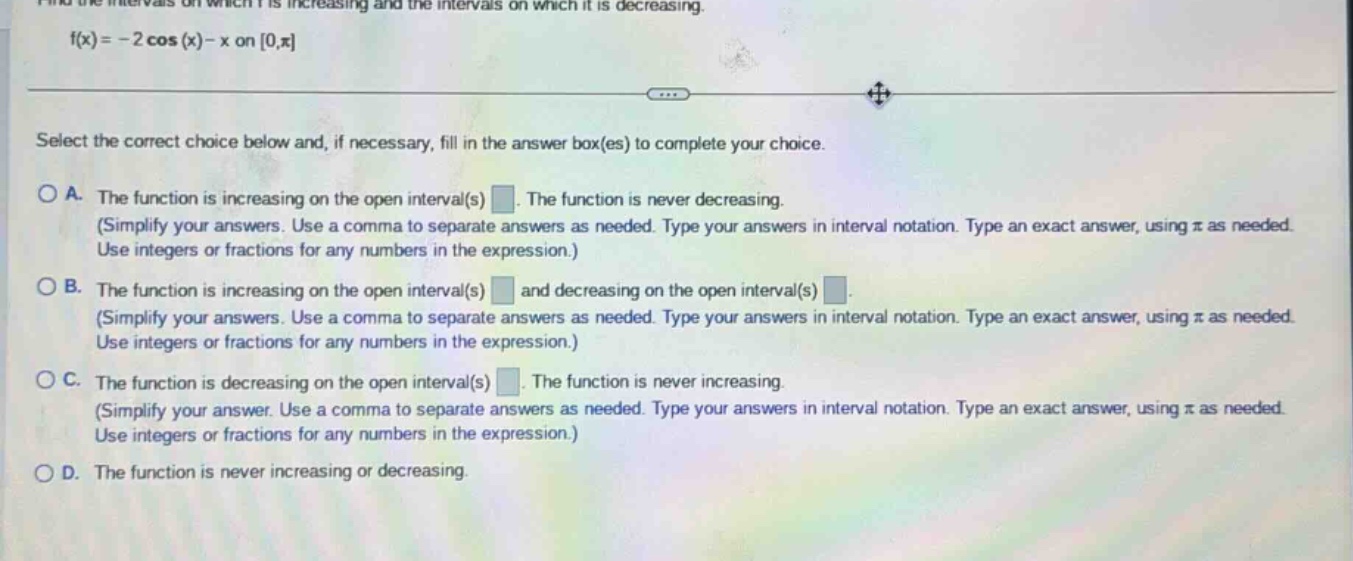
find the intervals on which f is increasing and the intervals on which it is decreasing. f(x)=-2 cos(x)-x on 0,π select the correct choice below and, if necessary, fill in the answer box(es) to complete your choice. a. the function is increasing on the open interval(s) . the function is never decreasing. (simplify your answers. use a comma to separate answers as needed. type your answers in interval notation. type an exact answer, using π as needed. use integers or fractions for any numbers in the expression.) b. the function is increasing on the open interval(s) and decreasing on the open interval(s) . (simplify your answers. use a comma to separate answers as needed. type your answers in interval notation. type an exact answer, using π as needed. use integers or fractions for any numbers in the expression.) c. the function is decreasing on the open interval(s) . the function is never increasing. (simplify your answer. use a comma to separate answers as needed. type your answers in interval notation. type an exact answer, using π as needed. use integers or fractions for any numbers in the expression.) d. the function is never increasing or decreasing.
Answer
Explanation:
Step1: Find the derivative
Differentiate $f(x)=- 2\cos(x)-x$ using sum - rule and derivative formulas. The derivative of $\cos(x)$ is $-\sin(x)$ and the derivative of $x$ is $1$. So $f^\prime(x)=2\sin(x)-1$.
Step2: Set the derivative equal to zero
Solve $2\sin(x)-1 = 0$ for $x$ in the interval $[0,\pi]$. Add $1$ to both sides: $2\sin(x)=1$, then $\sin(x)=\frac{1}{2}$. In the interval $[0,\pi]$, $x = \frac{\pi}{6}$ and $x=\frac{5\pi}{6}$.
Step3: Test intervals
Choose test - points in the intervals $\left(0,\frac{\pi}{6}\right)$, $\left(\frac{\pi}{6},\frac{5\pi}{6}\right)$ and $\left(\frac{5\pi}{6},\pi\right)$. For the interval $\left(0,\frac{\pi}{6}\right)$, let $x=\frac{\pi}{12}$. Then $f^\prime\left(\frac{\pi}{12}\right)=2\sin\left(\frac{\pi}{12}\right)-1<0$. For the interval $\left(\frac{\pi}{6},\frac{5\pi}{6}\right)$, let $x=\frac{\pi}{2}$. Then $f^\prime\left(\frac{\pi}{2}\right)=2\sin\left(\frac{\pi}{2}\right)-1=2 - 1=1>0$. For the interval $\left(\frac{5\pi}{6},\pi\right)$, let $x=\frac{11\pi}{12}$. Then $f^\prime\left(\frac{11\pi}{12}\right)=2\sin\left(\frac{11\pi}{12}\right)-1<0$.
Answer:
B. The function is increasing on the open interval(s) $\left(\frac{\pi}{6},\frac{5\pi}{6}\right)$ and decreasing on the open interval(s) $\left(0,\frac{\pi}{6}\right),\left(\frac{5\pi}{6},\pi\right)$