find the intervals on which f is increasing and the intervals on which it is decreasing. f(x)= -5 + x^2…
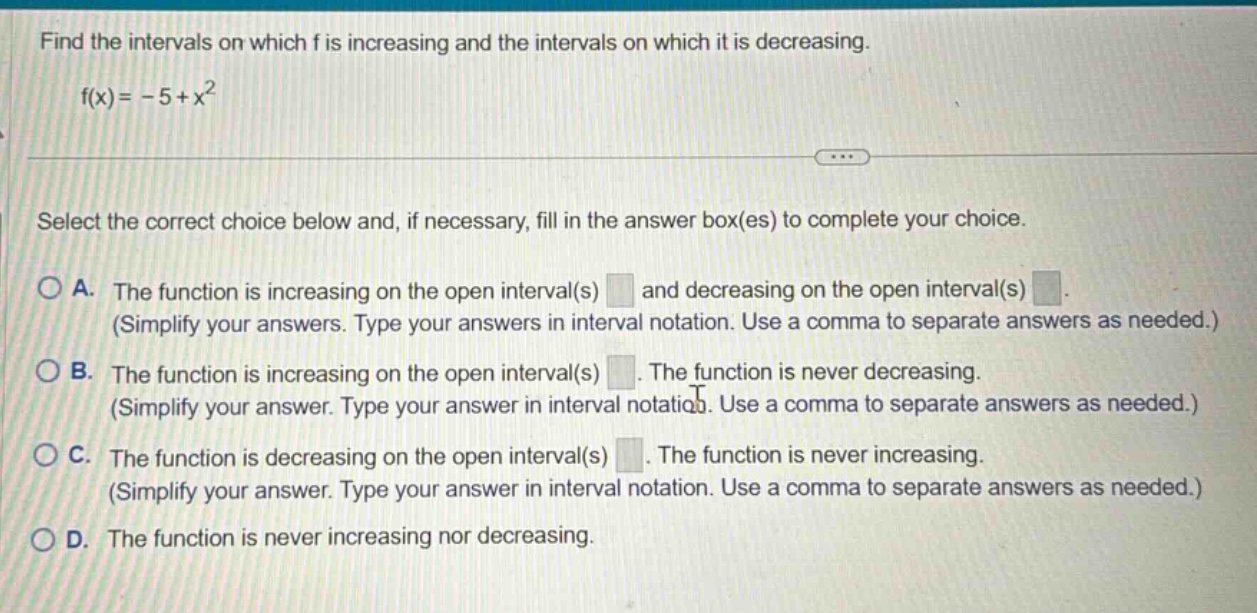
find the intervals on which f is increasing and the intervals on which it is decreasing. f(x)= -5 + x^2 select the correct choice below and, if necessary, fill in the answer box(es) to complete your choice. a. the function is increasing on the open interval(s) and decreasing on the open interval(s) (simplify your answers. type your answers in interval notation. use a comma to separate answers as needed.) b. the function is increasing on the open interval(s). the function is never decreasing. (simplify your answer. type your answer in interval notation. use a comma to separate answers as needed.) c. the function is decreasing on the open interval(s). the function is never increasing. (simplify your answer. type your answer in interval notation. use a comma to separate answers as needed.) d. the function is never increasing nor decreasing.
Answer
Explanation:
Step1: Find the derivative
The derivative of $f(x)=- 5 + x^{2}$ using the power - rule $(x^n)'=nx^{n - 1}$ is $f'(x)=2x$.
Step2: Find critical points
Set $f'(x) = 0$. So, $2x=0$, which gives $x = 0$ as the critical point.
Step3: Test intervals
Consider the intervals $(-\infty,0)$ and $(0,\infty)$. For the interval $(-\infty,0)$, let's choose a test - point, say $x=-1$. Then $f'(-1)=2\times(-1)=-2<0$. So, $f(x)$ is decreasing on $(-\infty,0)$. For the interval $(0,\infty)$, let's choose a test - point, say $x = 1$. Then $f'(1)=2\times1=2>0$. So, $f(x)$ is increasing on $(0,\infty)$.
Answer:
A. The function is increasing on the open interval(s) $(0,\infty)$ and decreasing on the open interval(s) $(-\infty,0)$