3. if f(x)=(1 + 1/x)^x, find lim f(x) as n→∞
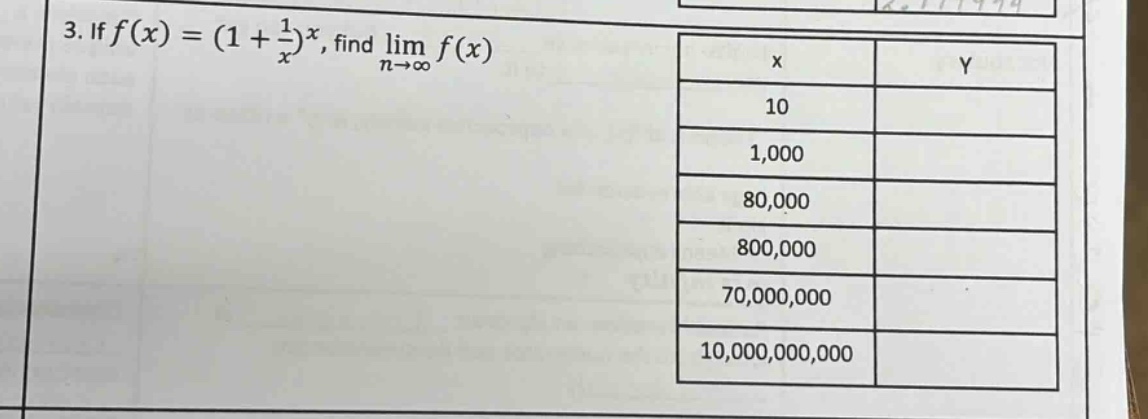
3. if f(x)=(1 + 1/x)^x, find lim f(x) as n→∞
Answer
Explanation:
Step1: Recall limit definition
The limit $\lim_{x\rightarrow\infty}(1 + \frac{1}{x})^{x}$ is a well - known limit in calculus, and its value is the mathematical constant $e$.
Step2: Calculate function values for table
For $x = 10$: $y=(1+\frac{1}{10})^{10}=\left(\frac{11}{10}\right)^{10}\approx 2.59374$. For $x = 1000$: $y=(1+\frac{1}{1000})^{1000}\approx 2.71692$. For $x = 80000$: $y=(1+\frac{1}{80000})^{80000}\approx 2.71827$. For $x = 800000$: $y=(1+\frac{1}{800000})^{800000}\approx 2.71828$. For $x = 70000000$: $y=(1+\frac{1}{70000000})^{70000000}\approx 2.71828$. For $x = 10000000000$: $y=(1+\frac{1}{10000000000})^{10000000000}\approx 2.71828$.
Answer:
$\lim_{x\rightarrow\infty}(1 + \frac{1}{x})^{x}=e\approx 2.71828$; For the table:
| x | Y |
|---|---|
| 10 | $\approx 2.59374$ |
| 1000 | $\approx 2.71692$ |
| 80000 | $\approx 2.71827$ |
| 800000 | $\approx 2.71828$ |
| 70000000 | $\approx 2.71828$ |
| 10000000000 | $\approx 2.71828$ |