find the limit of the following sequence or determine that the sequence diverges. {(-1)^n / (2n + 9)} select…
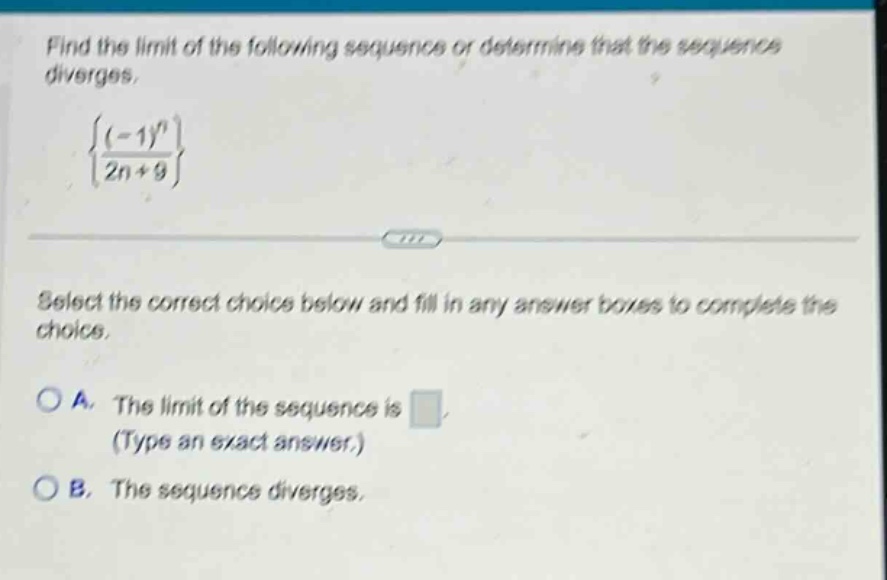
find the limit of the following sequence or determine that the sequence diverges. {(-1)^n / (2n + 9)} select the correct choice below and fill in any answer boxes to complete the choice. a. the limit of the sequence is (type an exact answer.) b. the sequence diverges.
Answer
Explanation:
Step1: Recall the squeeze - theorem
We know that (-1\leqslant(- 1)^n\leqslant1) for all (n\in N). Then (\frac{-1}{2n + 9}\leqslant\frac{(-1)^n}{2n+9}\leqslant\frac{1}{2n + 9}).
Step2: Find the limits of the bounding sequences
Calculate (\lim_{n\rightarrow\infty}\frac{-1}{2n + 9}). Let (t = 2n+9), as (n\rightarrow\infty), (t\rightarrow\infty). Then (\lim_{n\rightarrow\infty}\frac{-1}{2n + 9}=\lim_{t\rightarrow\infty}\frac{-1}{t}=0). Also, calculate (\lim_{n\rightarrow\infty}\frac{1}{2n + 9}). Let (t = 2n + 9), as (n\rightarrow\infty), (t\rightarrow\infty). Then (\lim_{n\rightarrow\infty}\frac{1}{2n + 9}=\lim_{t\rightarrow\infty}\frac{1}{t}=0).
Step3: Apply the squeeze - theorem
Since (\lim_{n\rightarrow\infty}\frac{-1}{2n + 9}=0) and (\lim_{n\rightarrow\infty}\frac{1}{2n + 9}=0), by the squeeze - theorem (\lim_{n\rightarrow\infty}\frac{(-1)^n}{2n+9}=0).
Answer:
A. The limit of the sequence is (0)