3) find the limit or state that the limit doesnt exist.\nlim(x→∞) (ln(x)/√x)
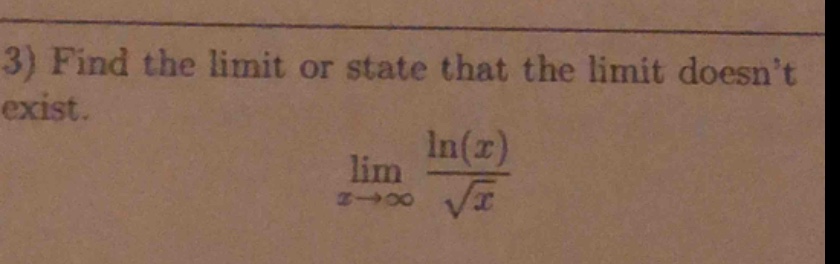
3) find the limit or state that the limit doesnt exist.\nlim(x→∞) (ln(x)/√x)
Answer
Explanation:
Step1: Identify indeterminate form
As $x\to\infty$, we have $\frac{\ln(x)}{\sqrt{x}}\to\frac{\infty}{\infty}$, so we can use L'Hopital's rule.
Step2: Differentiate numerator and denominator
The derivative of $\ln(x)$ is $\frac{1}{x}$, and the derivative of $\sqrt{x}=x^{\frac{1}{2}}$ is $\frac{1}{2}x^{-\frac{1}{2}}$. So the limit becomes $\lim_{x\to\infty}\frac{\frac{1}{x}}{\frac{1}{2}x^{-\frac{1}{2}}}$.
Step3: Simplify the new - formed limit
$\lim_{x\to\infty}\frac{\frac{1}{x}}{\frac{1}{2}x^{-\frac{1}{2}}}=\lim_{x\to\infty}\frac{2}{x^{\frac{1}{2}}}$.
Step4: Evaluate the limit
As $x\to\infty$, $\frac{2}{x^{\frac{1}{2}}}\to0$.
Answer:
$0$