find the limit. use lhospitals rule where appropriate. if there is a more elementary method, consider using…
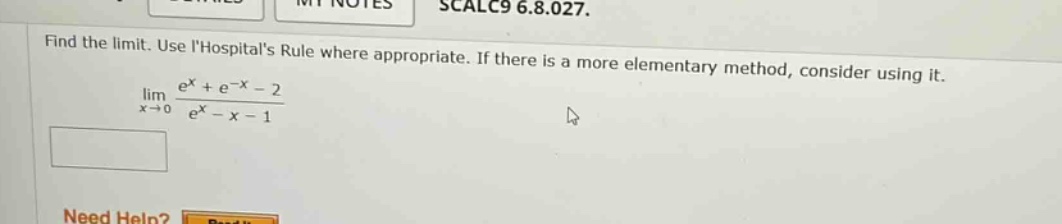
find the limit. use lhospitals rule where appropriate. if there is a more elementary method, consider using it. lim(x→0) (e^x + e^(-x) - 2)/(e^x - x - 1)
Answer
Explanation:
Step1: Check the form of the limit
When (x\rightarrow0), we substitute (x = 0) into (\frac{e^{x}+e^{-x}-2}{e^{x}-x - 1}). We get (\frac{e^{0}+e^{-0}-2}{e^{0}-0 - 1}=\frac{1 + 1-2}{1-0 - 1}=\frac{0}{0}), so L'Hopital's Rule can be applied.
Step2: Differentiate the numerator and denominator
Differentiate the numerator (y_1=e^{x}+e^{-x}-2), (y_1^\prime=e^{x}-e^{-x}). Differentiate the denominator (y_2=e^{x}-x - 1), (y_2^\prime=e^{x}-1). Now we find the limit (\lim_{x\rightarrow0}\frac{e^{x}-e^{-x}}{e^{x}-1}).
Step3: Check the form of the new - limit
Substitute (x = 0) into (\frac{e^{x}-e^{-x}}{e^{x}-1}), we get (\frac{e^{0}-e^{-0}}{e^{0}-1}=\frac{1 - 1}{1-1}=\frac{0}{0}), so we apply L'Hopital's Rule again.
Step4: Differentiate the new numerator and denominator
Differentiate the numerator (y_3=e^{x}-e^{-x}), (y_3^\prime=e^{x}+e^{-x}). Differentiate the denominator (y_4=e^{x}-1), (y_4^\prime=e^{x}). Now we find the limit (\lim_{x\rightarrow0}\frac{e^{x}+e^{-x}}{e^{x}}).
Step5: Evaluate the limit
Substitute (x = 0) into (\frac{e^{x}+e^{-x}}{e^{x}}), we have (\frac{e^{0}+e^{-0}}{e^{0}}=\frac{1 + 1}{1}=2).
Answer:
2