find the limit. use lhospitals rule if appropriate. if there is a more elementary method, lim (1 + a/x)^(bx)…
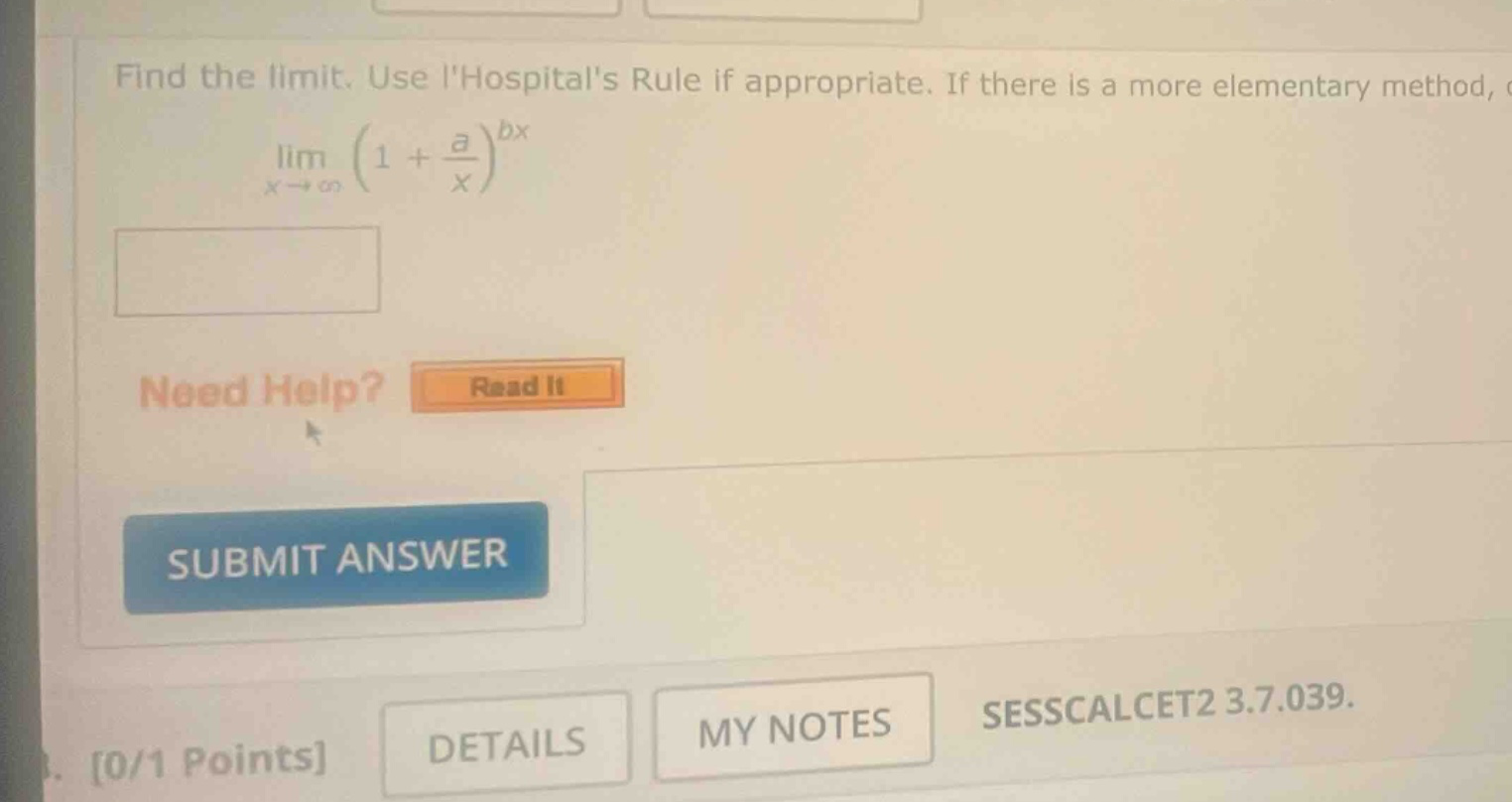
find the limit. use lhospitals rule if appropriate. if there is a more elementary method, lim (1 + a/x)^(bx) as x→∞ need help? read it submit answer 0/1 points details my notes sesscalcet2 3.7.039.
Answer
Explanation:
Step1: Recall the standard limit form
We know that $\lim_{t\rightarrow\infty}(1 + \frac{1}{t})^t=e$. Let $t=\frac{x}{a}$, then $x = at$. As $x\rightarrow\infty$, $t\rightarrow\infty$. The given limit $\lim_{x\rightarrow\infty}(1+\frac{a}{x})^{bx}$ can be rewritten.
Step2: Rewrite the limit
Substitute $t=\frac{x}{a}$ into the limit: [ \begin{align*} \lim_{x\rightarrow\infty}(1 + \frac{a}{x})^{bx}&=\lim_{t\rightarrow\infty}(1+\frac{1}{t})^{b(at)}\ &=\lim_{t\rightarrow\infty}[(1 + \frac{1}{t})^{t}]^{ab} \end{align*} ]
Step3: Apply the standard - limit result
Since $\lim_{t\rightarrow\infty}(1 + \frac{1}{t})^t = e$, we have $\lim_{t\rightarrow\infty}[(1 + \frac{1}{t})^{t}]^{ab}=e^{ab}$.
Answer:
$e^{ab}$