find the maclaurin series for the function 7ln(6 - x) using the definition of a maclaurin series, which has…
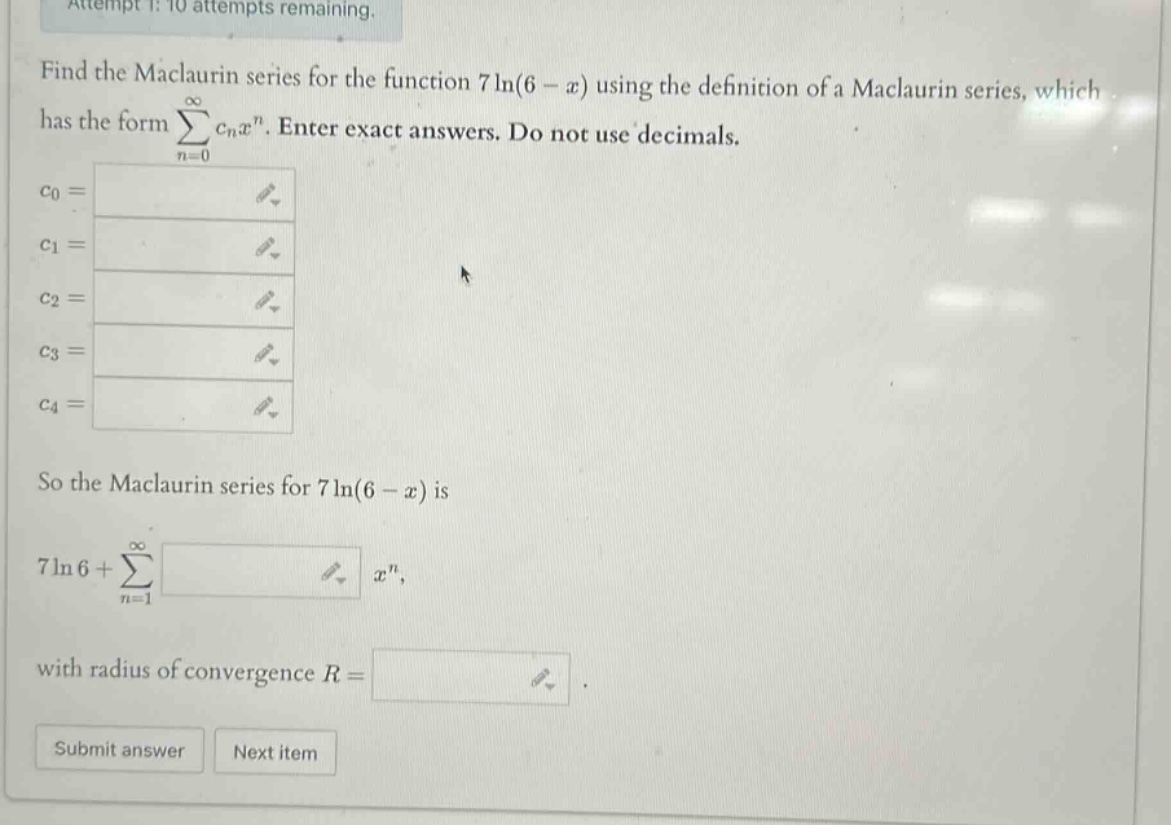
find the maclaurin series for the function 7ln(6 - x) using the definition of a maclaurin series, which has the form ∑(n = 0 to ∞) c_nx^n. enter exact answers. do not use decimals. c_0 = c_1 = c_2 = c_3 = c_4 = so the maclaurin series for 7ln(6 - x) is 7ln6+∑(n = 1 to ∞) x^n, with radius of convergence r = submit answer next item
Answer
Explanation:
Step1: Recall Maclaurin - series formula
The Maclaurin series of a function (f(x)) is given by (f(x)=\sum_{n = 0}^{\infty}c_{n}x^{n}), where (c_{n}=\frac{f^{(n)}(0)}{n!}), and (f^{(n)}(x)) is the (n) - th derivative of (f(x)). First, find (f(0)) for (f(x)=7\ln(6 - x)). [f(0)=7\ln(6-0)=7\ln6] So, (c_{0}=7\ln6).
Step2: Find the first - derivative
Differentiate (y = 7\ln(6 - x)) using the chain - rule. The derivative of (\ln(u)) with respect to (x) is (\frac{u'}{u}), where (u = 6 - x) and (u'=-1). So, (y'=f^{(1)}(x)=\frac{-7}{6 - x}). Then (f^{(1)}(0)=\frac{-7}{6}), and (c_{1}=\frac{f^{(1)}(0)}{1!}=-\frac{7}{6}).
Step3: Find the second - derivative
Differentiate (y'=\frac{-7}{6 - x}=-7(6 - x)^{-1}) using the power - rule ((u^{n})'=nu^{n - 1}u'). Here, (u = 6 - x), (n=-1), and (u'=-1). So, (y''=f^{(2)}(x)=-7(-1)(6 - x)^{-2}=\frac{7}{(6 - x)^{2}}). Then (f^{(2)}(0)=\frac{7}{36}), and (c_{2}=\frac{f^{(2)}(0)}{2!}=\frac{7}{72}).
Step4: Find the third - derivative
Differentiate (y''=\frac{7}{(6 - x)^{2}}=7(6 - x)^{-2}) using the power - rule. (y'''=f^{(3)}(x)=7(-2)(6 - x)^{-3}=\frac{-14}{(6 - x)^{3}}). Then (f^{(3)}(0)=\frac{-14}{216}=-\frac{7}{108}), and (c_{3}=\frac{f^{(3)}(0)}{3!}=-\frac{7}{648}).
Step5: Find the fourth - derivative
Differentiate (y'''=\frac{-14}{(6 - x)^{3}}=-14(6 - x)^{-3}) using the power - rule. (y^{(4)}=f^{(4)}(x)=-14(-3)(6 - x)^{-4}=\frac{42}{(6 - x)^{4}}). Then (f^{(4)}(0)=\frac{42}{1296}=\frac{7}{216}), and (c_{4}=\frac{f^{(4)}(0)}{4!}=\frac{7}{5184}).
Step6: Find the general term
We can observe that (c_{n}=\frac{7(-1)^{n}}{n\cdot6^{n}}) for (n\geq1). So the Maclaurin series is (7\ln6+\sum_{n = 1}^{\infty}\frac{7(-1)^{n}}{n\cdot6^{n}}x^{n}).
Step7: Find the radius of convergence
Use the ratio test. Let (a_{n}=\frac{7(-1)^{n}}{n\cdot6^{n}}x^{n}). Then (\lim_{n\rightarrow\infty}\left|\frac{a_{n + 1}}{a_{n}}\right|=\lim_{n\rightarrow\infty}\left|\frac{\frac{7(-1)^{n+1}}{(n + 1)\cdot6^{n+1}}x^{n+1}}{\frac{7(-1)^{n}}{n\cdot6^{n}}x^{n}}\right|=\lim_{n\rightarrow\infty}\left|\frac{n\cdot(-1)x}{6(n + 1)}\right|=\left|\frac{x}{6}\right|). For convergence, (\left|\frac{x}{6}\right|\lt1), so the radius of convergence (R = 6).
Answer:
(c_{0}=7\ln6) (c_{1}=-\frac{7}{6}) (c_{2}=\frac{7}{72}) (c_{3}=-\frac{7}{648}) (c_{4}=\frac{7}{5184}) The series is (7\ln6+\sum_{n = 1}^{\infty}\frac{7(-1)^{n}}{n\cdot6^{n}}x^{n}) (R = 6)