find the maclaurin series for the function f(x) = 1 / √(9 - x) and its radius of convergence. solution we…
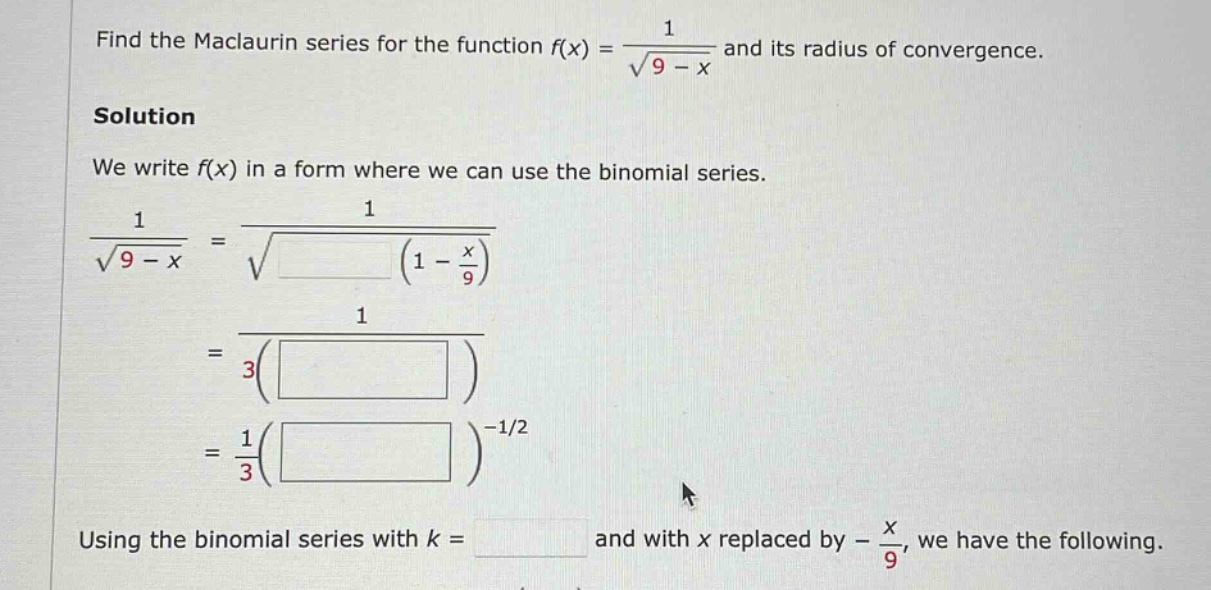
find the maclaurin series for the function f(x) = 1 / √(9 - x) and its radius of convergence. solution we write f(x) in a form where we can use the binomial series. 1 / √(9 - x) = 1 / √( (1 - x/9) ) = 1 / 3( ) = 1/3( )^(-1/2) using the binomial series with k = and with x replaced by - x/9, we have the following.
Answer
Explanation:
Step1: Rewrite the function
We rewrite $\frac{1}{\sqrt{9 - x}}$ as $\frac{1}{\sqrt{9(1-\frac{x}{9})}}=\frac{1}{3\sqrt{1-\frac{x}{9}}}=\frac{1}{3}(1 - \frac{x}{9})^{-\frac{1}{2}}$.
Step2: Recall the binomial - series formula
The binomial series formula is $(1 + y)^k=\sum_{n = 0}^{\infty}\binom{k}{n}y^{n}$, where $\binom{k}{n}=\frac{k(k - 1)\cdots(k-(n - 1))}{n!}$ and $|y|\lt1$. Here $y=-\frac{x}{9}$ and $k =-\frac{1}{2}$.
Step3: Find the Maclaurin series
We have $\binom{-\frac{1}{2}}{n}=\frac{(-\frac{1}{2})(-\frac{1}{2}-1)\cdots(-\frac{1}{2}-(n - 1))}{n!}=\frac{(-1)^{n}}{2^{n}}\frac{1\times3\times\cdots\times(2n - 1)}{n!}$. So, $(1-\frac{x}{9})^{-\frac{1}{2}}=\sum_{n = 0}^{\infty}\binom{-\frac{1}{2}}{n}(-\frac{x}{9})^{n}=\sum_{n = 0}^{\infty}\frac{1\times3\times\cdots\times(2n - 1)}{2^{n}n!}(\frac{x}{9})^{n}$. Then $f(x)=\frac{1}{3}\sum_{n = 0}^{\infty}\frac{1\times3\times\cdots\times(2n - 1)}{2^{n}n!}(\frac{x}{9})^{n}=\sum_{n = 0}^{\infty}\frac{1\times3\times\cdots\times(2n - 1)}{3\times2^{n}n!9^{n}}x^{n}$.
Step4: Find the radius of convergence
Using the ratio - test, let $a_{n}=\frac{1\times3\times\cdots\times(2n - 1)}{3\times2^{n}n!9^{n}}x^{n}$. Then $\lim_{n\rightarrow\infty}\left|\frac{a_{n + 1}}{a_{n}}\right|=\lim_{n\rightarrow\infty}\left|\frac{\frac{1\times3\times\cdots\times(2n+1)}{3\times2^{n + 1}(n + 1)!9^{n+1}}x^{n+1}}{\frac{1\times3\times\cdots\times(2n - 1)}{3\times2^{n}n!9^{n}}x^{n}}\right|$. Simplify the ratio: [ \begin{align*} \lim_{n\rightarrow\infty}\left|\frac{a_{n + 1}}{a_{n}}\right|&=\lim_{n\rightarrow\infty}\left|\frac{1\times3\times\cdots\times(2n + 1)}{3\times2^{n+1}(n + 1)!9^{n+1}}\times\frac{3\times2^{n}n!9^{n}}{1\times3\times\cdots\times(2n - 1)}\times x\right|\ &=\lim_{n\rightarrow\infty}\left|\frac{2n + 1}{2(n + 1)\times9}x\right|\ &=\lim_{n\rightarrow\infty}\left|\frac{2+\frac{1}{n}}{2(1+\frac{1}{n})\times9}x\right|=\frac{|x|}{9} \end{align*} ] For convergence, $\frac{|x|}{9}\lt1$, so $|x|\lt9$. The radius of convergence $R = 9$.
Answer:
The Maclaurin series for $f(x)$ is $\sum_{n = 0}^{\infty}\frac{1\times3\times\cdots\times(2n - 1)}{3\times2^{n}n!9^{n}}x^{n}$, and the radius of convergence $R = 9$.