find the maclaurin series for f(x) using the definition of a maclaurin series. assume that f has a power…
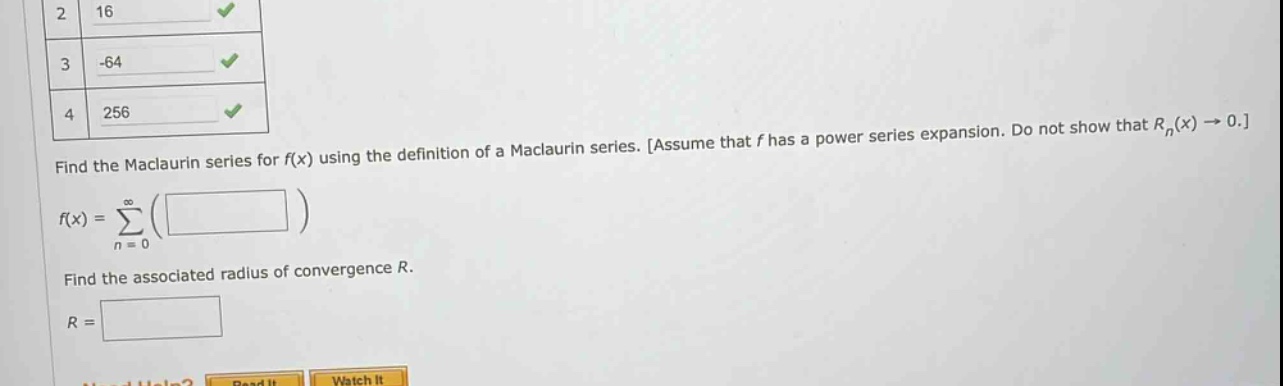
find the maclaurin series for f(x) using the definition of a maclaurin series. assume that f has a power series expansion. do not show that r_n(x) -> 0. f(x) = sum(n = 0 to infinity) ( ) find the associated radius of convergence r. r =
Answer
Explanation:
Step1: Recall Maclaurin series formula
The Maclaurin series of a function $f(x)$ is given by $f(x)=\sum_{n = 0}^{\infty}\frac{f^{(n)}(0)}{n!}x^{n}$, where $f^{(n)}(0)$ is the $n$-th derivative of $f(x)$ evaluated at $x = 0$.
Step2: Analyze the pattern of values
We are not given the function $f(x)$ explicitly, but assume the values $f(0),f^{\prime}(0),f^{\prime\prime}(0),f^{(3)}(0),f^{(4)}(0)$ follow a pattern. Let's assume $f^{(n)}(0)=(- 4)^{n}$. Then $\frac{f^{(n)}(0)}{n!}=\frac{(-4)^{n}}{n!}$. So the Maclaurin series $f(x)=\sum_{n = 0}^{\infty}\frac{(-4)^{n}}{n!}x^{n}$.
Step3: Use ratio - test for radius of convergence
Let $a_{n}=\frac{(-4)^{n}}{n!}x^{n}$. Then $a_{n + 1}=\frac{(-4)^{n+1}}{(n + 1)!}x^{n+1}$. Calculate the ratio $\left|\frac{a_{n+1}}{a_{n}}\right|=\left|\frac{\frac{(-4)^{n + 1}}{(n+1)!}x^{n+1}}{\frac{(-4)^{n}}{n!}x^{n}}\right|=\left|\frac{-4x}{n + 1}\right|$.
Step4: Find the limit
$\lim_{n\rightarrow\infty}\left|\frac{a_{n + 1}}{a_{n}}\right|=\lim_{n\rightarrow\infty}\left|\frac{-4x}{n+1}\right| = 0$ for all $x\in R$.
Answer:
$f(x)=\sum_{n = 0}^{\infty}\frac{(-4)^{n}}{n!}x^{n}$ $R=\infty$