(a) find the open intervals on which the function shown in the graph is increasing and decreasing. (b)…
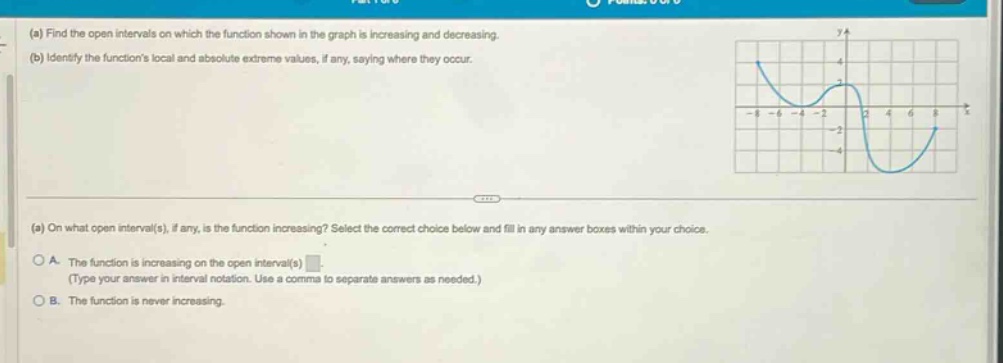
(a) find the open intervals on which the function shown in the graph is increasing and decreasing. (b) identify the functions local and absolute extreme values, if any, saying where they occur. (a) on what open interval(s), if any, is the function increasing? select the correct choice below and fill in any answer boxes within your choice. a. the function is increasing on the open interval(s) (type your answer in interval - notation. use a comma to separate answers as needed.) b. the function is never increasing.
Answer
Explanation:
Step1: Recall increasing - decreasing concept
A function is increasing when the graph rises from left to right and decreasing when it falls from left to right.
Step2: Analyze the graph for increasing intervals
Looking at the graph, the function is increasing on the intervals ((-6,-2)) and ((4,8)).
Step3: Analyze the graph for decreasing intervals
The function is decreasing on the intervals ((-8,-6)) and ((-2,4)).
Step4: Identify local and absolute extrema
Local maxima occur where the function changes from increasing to decreasing. Local minima occur where the function changes from decreasing to increasing.
- Local maximum value of (y = 4) occurs at (x=-2).
- Local minimum values: (y=-4) occurs at (x = 4).
- To find absolute extrema, we consider the endpoints and local extrema. Since we have a closed - interval view of the graph (from (x=-8) to (x = 8)), the absolute maximum value of (y = 4) occurs at (x=-2) and the absolute minimum value of (y=-4) occurs at (x = 4).
Answer:
(a) A. The function is increasing on the open intervals ((-6,-2),(4,8)) (b) Local maximum: (y = 4) at (x=-2); Local minimum: (y=-4) at (x = 4); Absolute maximum: (y = 4) at (x=-2); Absolute minimum: (y=-4) at (x = 4)