find a possible formula for the trigonometric function whose values are in the following table.\n|x|0|1|2|3|4…
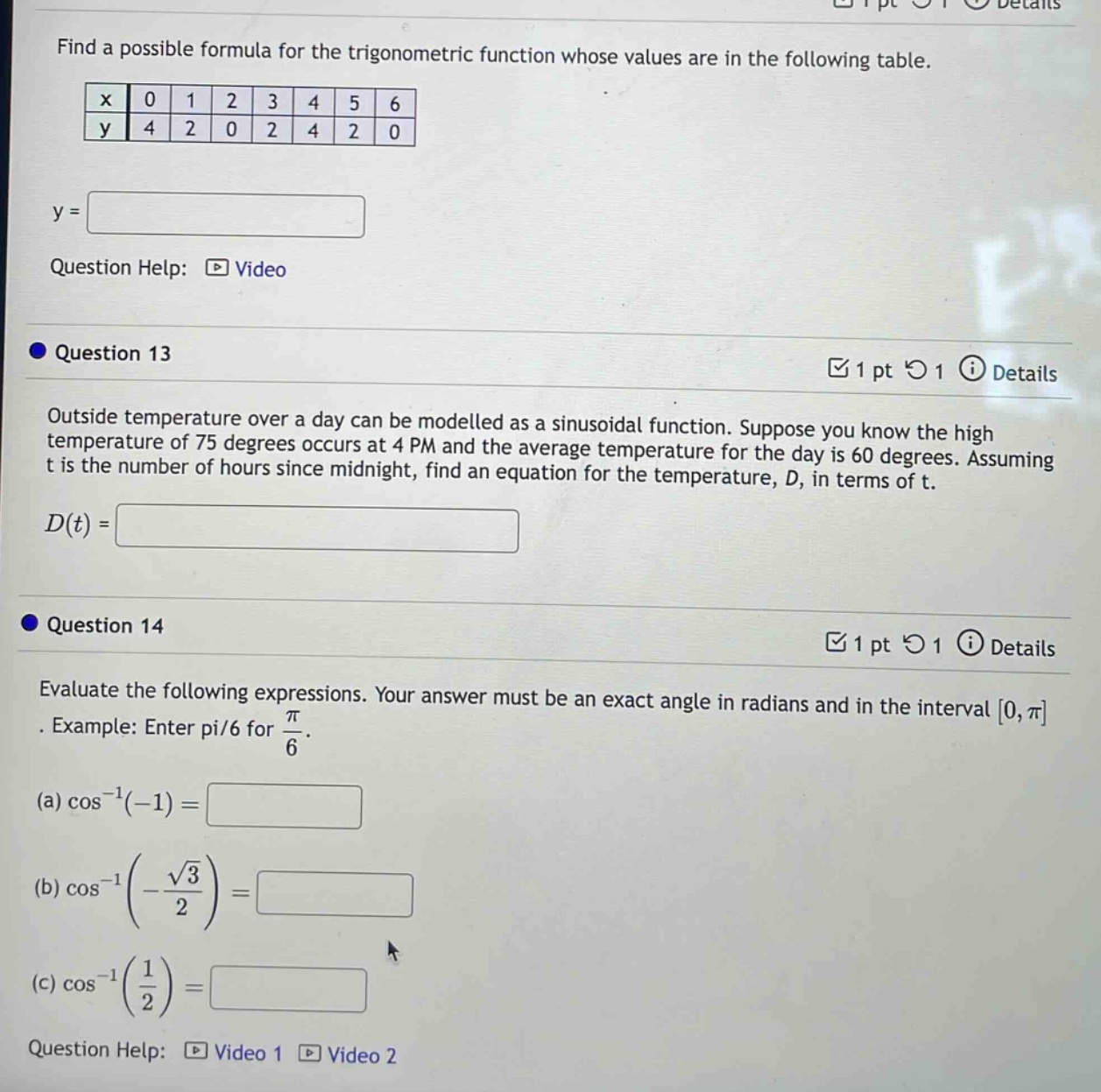
find a possible formula for the trigonometric function whose values are in the following table.\n|x|0|1|2|3|4|5|6|\n|y|4|2|0|2|4|2|0|\ny = \nquestion help: video\nquestion 13\noutside temperature over a day can be modelled as a sinusoidal function. suppose you know the high temperature of 75 degrees occurs at 4 pm and the average temperature for the day is 60 degrees. assuming t is the number of hours since midnight, find an equation for the temperature, d, in terms of t.\nd(t) =\nquestion 14\nevaluate the following expressions. your answer must be an exact angle in radians and in the interval 0, π. example: enter pi/6 for π/6.\n(a) cos⁻¹(-1) =\n(b) cos⁻¹(-√3/2) =\n(c) cos⁻¹(1/2) =\nquestion help: video 1 video 2
Answer
Explanation:
Question 12
Step1: Identify the type of trig - function
The table shows a periodic pattern. The general form of a sinusoidal function is $y = A\sin(B(x - C))+D$ or $y = A\cos(B(x - C))+D$. The period $T$ can be found from the table. The pattern repeats every $4$ units, so $T = 4$. Using the formula $T=\frac{2\pi}{B}$, we have $4=\frac{2\pi}{B}$, then $B=\frac{\pi}{2}$.
Step2: Find the amplitude $A$
The maximum value is $4$ and the minimum value is $0$. The amplitude $A=\frac{4 - 0}{2}=2$.
Step3: Find the vertical shift $D$
The vertical shift $D=\frac{4 + 0}{2}=2$.
Step4: Find the phase - shift $C$
Using the cosine form $y = A\cos(B(x - C))+D$, when $x = 0$, $y = 4$. Substituting $A = 2$, $B=\frac{\pi}{2}$, $D = 2$ into $y = 2\cos(\frac{\pi}{2}(x - C))+2$, we get $4=2\cos(-\frac{\pi}{2}C)+2$. Then $\cos(-\frac{\pi}{2}C)=1$, so $C = 0$. The function is $y = 2\cos(\frac{\pi}{2}x)+2$.
Question 13
Step1: Determine the amplitude $A$
The high temperature is $75$ and the average temperature is $60$. The amplitude $A=75 - 60=15$.
Step2: Find the vertical shift $D$
The vertical shift $D = 60$.
Step3: Determine the period $T$ and $B$
The period of a day is $T = 24$ hours. Using $T=\frac{2\pi}{B}$, we have $B=\frac{2\pi}{24}=\frac{\pi}{12}$.
Step4: Find the phase - shift $C$
The high temperature occurs at $t = 16$ (4 PM is 16 hours since midnight). For a cosine function $D(t)=A\cos(B(t - C))+D$, when $D(t)$ is maximum, $\cos(B(t - C)) = 1$. Substituting $A = 15$, $B=\frac{\pi}{12}$, $D = 60$ and $t = 16$ into $D(t)=15\cos(\frac{\pi}{12}(t - C))+60$, we get $75=15\cos(\frac{\pi}{12}(16 - C))+60$. Then $\cos(\frac{\pi}{12}(16 - C)) = 1$, so $\frac{\pi}{12}(16 - C)=2k\pi,k\in\mathbb{Z}$. Taking $k = 0$, we find $C = 16$. The function is $D(t)=15\cos(\frac{\pi}{12}(t - 16))+60$.
Question 14
(a)
Recall the definition of the inverse - cosine function $y=\cos^{-1}(x)$ where $y\in[0,\pi]$ and $\cos(y)=x$. If $x=-1$, then $\cos(y)=-1$ and $y = \pi$.
(b)
If $\cos(y)=-\frac{\sqrt{3}}{2}$ and $y\in[0,\pi]$, then $y=\frac{5\pi}{6}$.
(c)
If $\cos(y)=\frac{1}{2}$ and $y\in[0,\pi]$, then $y=\frac{\pi}{3}$.
Answer:
Question 12
$y = 2\cos(\frac{\pi}{2}x)+2$
Question 13
$D(t)=15\cos(\frac{\pi}{12}(t - 16))+60$
Question 14
(a) $\pi$ (b) $\frac{5\pi}{6}$ (c) $\frac{\pi}{3}$