find a power series representation for f(x) = arccot(x). solution we observe that f(x) = -1/(1 + x^2) and…
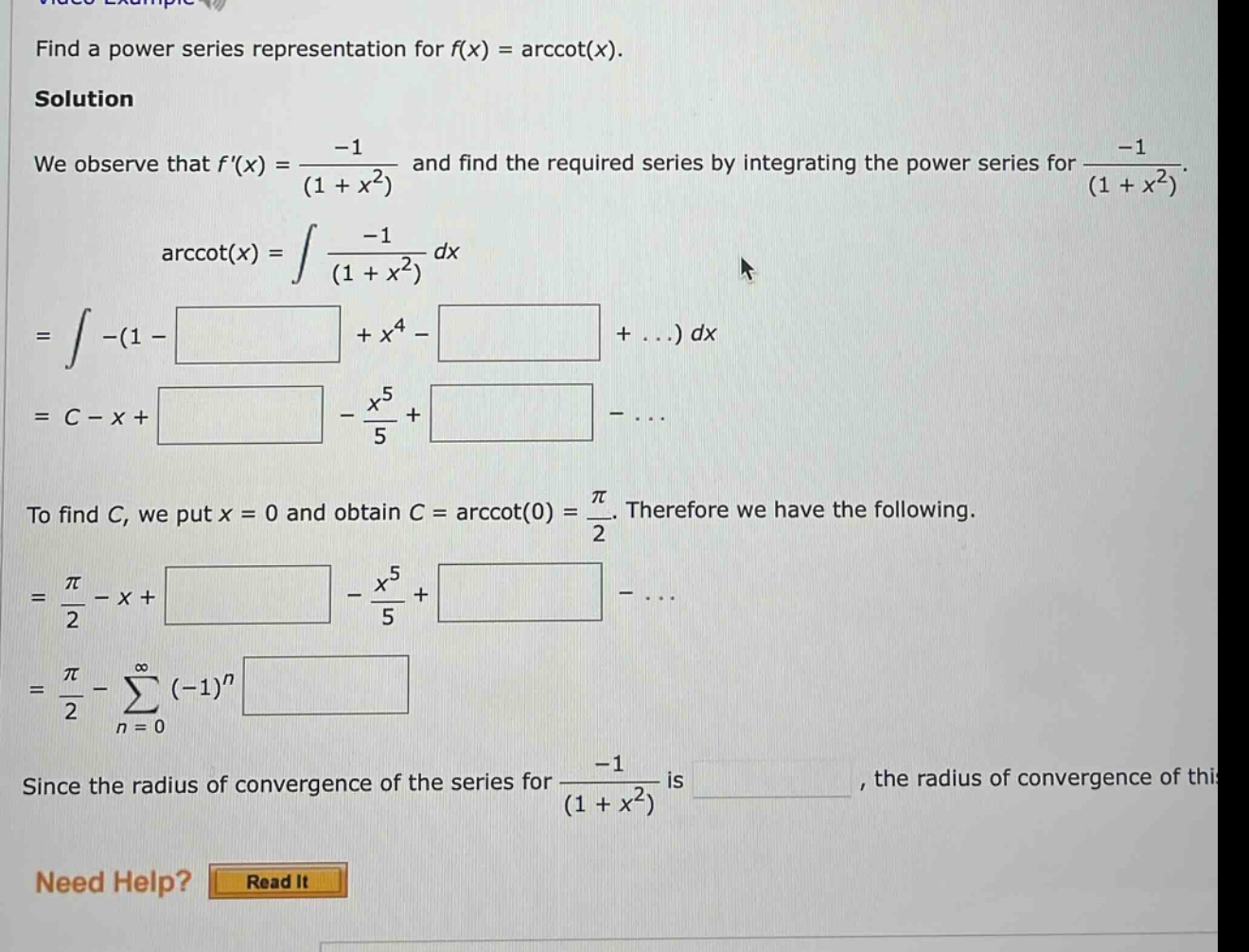
find a power series representation for f(x) = arccot(x). solution we observe that f(x) = -1/(1 + x^2) and find the required series by integrating the power series for -1/(1 + x^2). arccot(x) = ∫ -1/(1 + x^2) dx = ∫ -(1 - + x^4 - + ...) dx = c - x + - x^5/5 + - ... to find c, we put x = 0 and obtain c = arccot(0) = π/2. therefore we have the following. = π/2 - x + - x^5/5 + - ... = π/2 - ∑ (-1)^n from n = 0 since the radius of convergence of the series for -1/(1 + x^2) is , the radius of convergence of this need help? read it
Answer
Explanation:
Step1: Recall geometric - series formula
We know that $\frac{1}{1 + t}=\sum_{n = 0}^{\infty}(-t)^{n}$, for $|t|\lt1$. Let $t=x^{2}$, then $\frac{-1}{1 + x^{2}}=-\sum_{n = 0}^{\infty}(-x^{2})^{n}=-\sum_{n = 0}^{\infty}(- 1)^{n}x^{2n}=\sum_{n = 0}^{\infty}(-1)^{n + 1}x^{2n}$, for $|x^{2}|\lt1$ (i.e., $|x|\lt1$).
Step2: Integrate the power - series
$\text{arccot}(x)=\int\frac{-1}{1 + x^{2}}dx=\int\sum_{n = 0}^{\infty}(-1)^{n+1}x^{2n}dx$. By the power - rule of integration $\int x^{m}dx=\frac{x^{m + 1}}{m+1}+C$ ($m\neq - 1$), we have $\text{arccot}(x)=C+\sum_{n = 0}^{\infty}\frac{(-1)^{n + 1}}{2n+1}x^{2n + 1}$.
Step3: Determine the constant $C$
When $x = 0$, $\text{arccot}(0)=\frac{\pi}{2}$, so $C=\frac{\pi}{2}$. Then $\text{arccot}(x)=\frac{\pi}{2}-\sum_{n = 0}^{\infty}\frac{(-1)^{n}}{2n + 1}x^{2n+1}$.
Step4: Find the radius of convergence
The power - series for $\frac{-1}{1 + x^{2}}=\sum_{n = 0}^{\infty}(-1)^{n + 1}x^{2n}$ converges for $|x^{2}|\lt1$, i.e., $|x|\lt1$. When we integrate a power - series $\sum_{n = 0}^{\infty}a_{n}x^{n}$ with radius of convergence $R$, the radius of convergence of the integrated power - series $\sum_{n = 0}^{\infty}\frac{a_{n}}{n + 1}x^{n+1}$ is the same as that of the original power - series. So the radius of convergence of the power - series for $\text{arccot}(x)$ is $R = 1$.
Answer:
$\text{arccot}(x)=\frac{\pi}{2}-\sum_{n = 0}^{\infty}\frac{(-1)^{n}}{2n+1}x^{2n + 1}$, radius of convergence $R = 1$