find the power series representation for g centered at 0 by differentiating or integrating the power series…
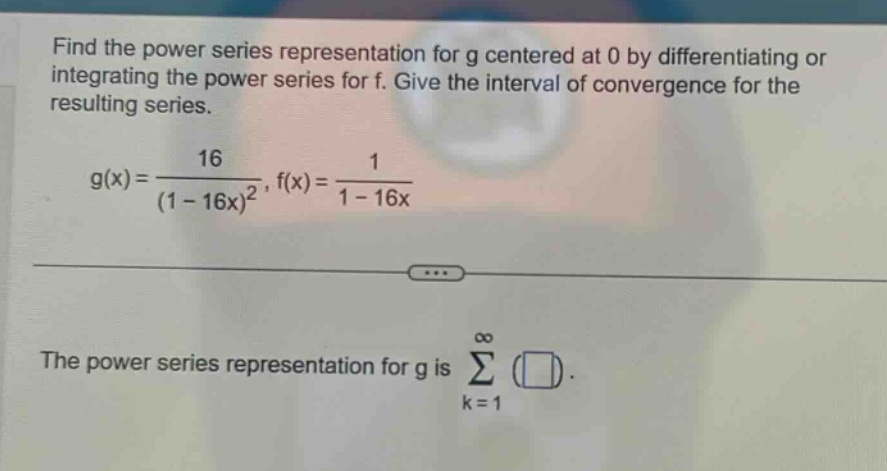
find the power series representation for g centered at 0 by differentiating or integrating the power series for f. give the interval of convergence for the resulting series. g(x)=16/(1 - 16x)^2, f(x)=1/(1 - 16x) the power series representation for g is ∑(k = 1 to ∞)()
Answer
Explanation:
Step1: Recall geometric - series formula
The geometric - series formula is $\frac{1}{1 - t}=\sum_{k = 0}^{\infty}t^{k}$, for $|t|\lt1$. Let $t = 16x$, then $f(x)=\frac{1}{1 - 16x}=\sum_{k = 0}^{\infty}(16x)^{k}=\sum_{k = 0}^{\infty}16^{k}x^{k}$, for $|16x|\lt1$ or $|x|\lt\frac{1}{16}$.
Step2: Differentiate $f(x)$
Differentiate $f(x)=\sum_{k = 0}^{\infty}16^{k}x^{k}$ with respect to $x$. Using the power - rule for differentiation $\left(x^{n}\right)'=nx^{n - 1}$, we have $f^\prime(x)=\sum_{k = 1}^{\infty}k\cdot16^{k}x^{k - 1}$. Since $g(x)=\frac{16}{(1 - 16x)^{2}}$, and we know that $f^\prime(x)=\frac{16}{(1 - 16x)^{2}}$ (by differentiating $y=\frac{1}{1 - 16x}=(1 - 16x)^{-1}$ using the chain - rule: $y^\prime=(-1)(1 - 16x)^{-2}(-16)=\frac{16}{(1 - 16x)^{2}}$). So $g(x)=\sum_{k = 1}^{\infty}k\cdot16^{k}x^{k - 1}$.
Step3: Adjust the index
Let $n=k - 1$, then $k=n + 1$. The power series for $g(x)$ can be rewritten as $\sum_{n = 0}^{\infty}(n + 1)\cdot16^{n+1}x^{n}$.
Step4: Find the interval of convergence
We started with the geometric series $\frac{1}{1 - t}=\sum_{k = 0}^{\infty}t^{k}$ which converges for $|t|\lt1$. When $t = 16x$, the original series for $f(x)$ converges for $|16x|\lt1$ or $|x|\lt\frac{1}{16}$. Differentiating a power series $\sum_{k = 0}^{\infty}a_{k}x^{k}$ with radius of convergence $R$ gives a new power series $\sum_{k = 1}^{\infty}ka_{k}x^{k - 1}$ with the same radius of convergence. So the interval of convergence for the power series of $g(x)$ is $|x|\lt\frac{1}{16}$, or $\left(-\frac{1}{16},\frac{1}{16}\right)$.
Answer:
$\sum_{k = 0}^{\infty}(k + 1)\cdot16^{k + 1}x^{k}$, interval of convergence: $\left(-\frac{1}{16},\frac{1}{16}\right)$