find the power series representation for g centered at 0 by differentiating or integrating the power series…
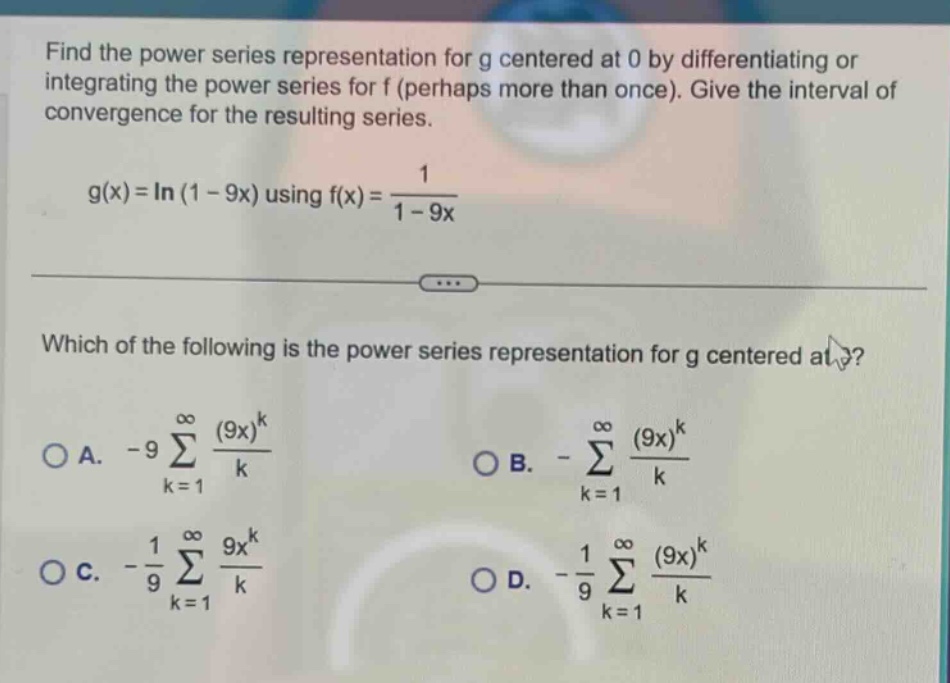
find the power series representation for g centered at 0 by differentiating or integrating the power series for f (perhaps more than once). give the interval of convergence for the resulting series. g(x)=ln(1 - 9x) using f(x)=1/(1 - 9x) which of the following is the power series representation for g centered at 0? a. -9∑(k = 1 to ∞) ((9x)^k)/k b. -∑(k = 1 to ∞) ((9x)^k)/k c. -1/9∑(k = 1 to ∞) (9x^k)/k d. -1/9∑(k = 1 to ∞) ((9x)^k)/k
Answer
Explanation:
Step1: Recall geometric - series formula
The geometric - series formula is $\frac{1}{1 - t}=\sum_{k = 0}^{\infty}t^{k}$, for $|t|\lt1$. Let $t = 9x$, then $f(x)=\frac{1}{1 - 9x}=\sum_{k = 0}^{\infty}(9x)^{k}=\sum_{k = 0}^{\infty}9^{k}x^{k}$, for $|9x|\lt1$ or $|x|\lt\frac{1}{9}$.
Step2: Integrate $f(x)$ to get $g(x)$
We know that $g(x)=\ln(1 - 9x)$ and $g^\prime(x)=-\frac{9}{1 - 9x}$. Since $f(x)=\frac{1}{1 - 9x}=\sum_{k = 0}^{\infty}(9x)^{k}$, then $g^\prime(x)=-9\sum_{k = 0}^{\infty}(9x)^{k}=- \sum_{k = 0}^{\infty}9^{k + 1}x^{k}$. Integrating term - by - term: [ \begin{align*} g(x)&=\int g^\prime(x)dx\ &=-\int\sum_{k = 0}^{\infty}9^{k+1}x^{k}dx\ &=C-\sum_{k = 0}^{\infty}\frac{9^{k + 1}x^{k+1}}{k + 1} \end{align*} ] When $x = 0$, $g(0)=\ln(1-0)=0$. Substituting $x = 0$ into the above formula, we get $C = 0$. Let $n=k + 1$, then $g(x)=-\sum_{n = 1}^{\infty}\frac{(9x)^{n}}{n}=-\sum_{k = 1}^{\infty}\frac{(9x)^{k}}{k}$.
Step3: Find the interval of convergence
We started with the geometric series $\frac{1}{1 - 9x}=\sum_{k = 0}^{\infty}(9x)^{k}$ which converges for $|9x|\lt1$ or $|x|\lt\frac{1}{9}$. When we integrate a power series, the radius of convergence remains the same. We need to check the endpoints:
- When $x=\frac{1}{9}$, $g(x)=-\sum_{k = 1}^{\infty}\frac{(9\times\frac{1}{9})^{k}}{k}=-\sum_{k = 1}^{\infty}\frac{1}{k}$, which is the harmonic series and diverges.
- When $x=-\frac{1}{9}$, $g(x)=-\sum_{k = 1}^{\infty}\frac{[9\times(-\frac{1}{9})]^{k}}{k}=\sum_{k = 1}^{\infty}\frac{(- 1)^{k + 1}}{k}$, which is the alternating harmonic series and converges.
So the interval of convergence is $[-\frac{1}{9},\frac{1}{9})$.
Answer:
B. $-\sum_{k = 1}^{\infty}\frac{(9x)^{k}}{k}$