find radius of convergence and interval of convergence for the following series. \n∑(k = 1 to ∞) ((4x - 8)^k…
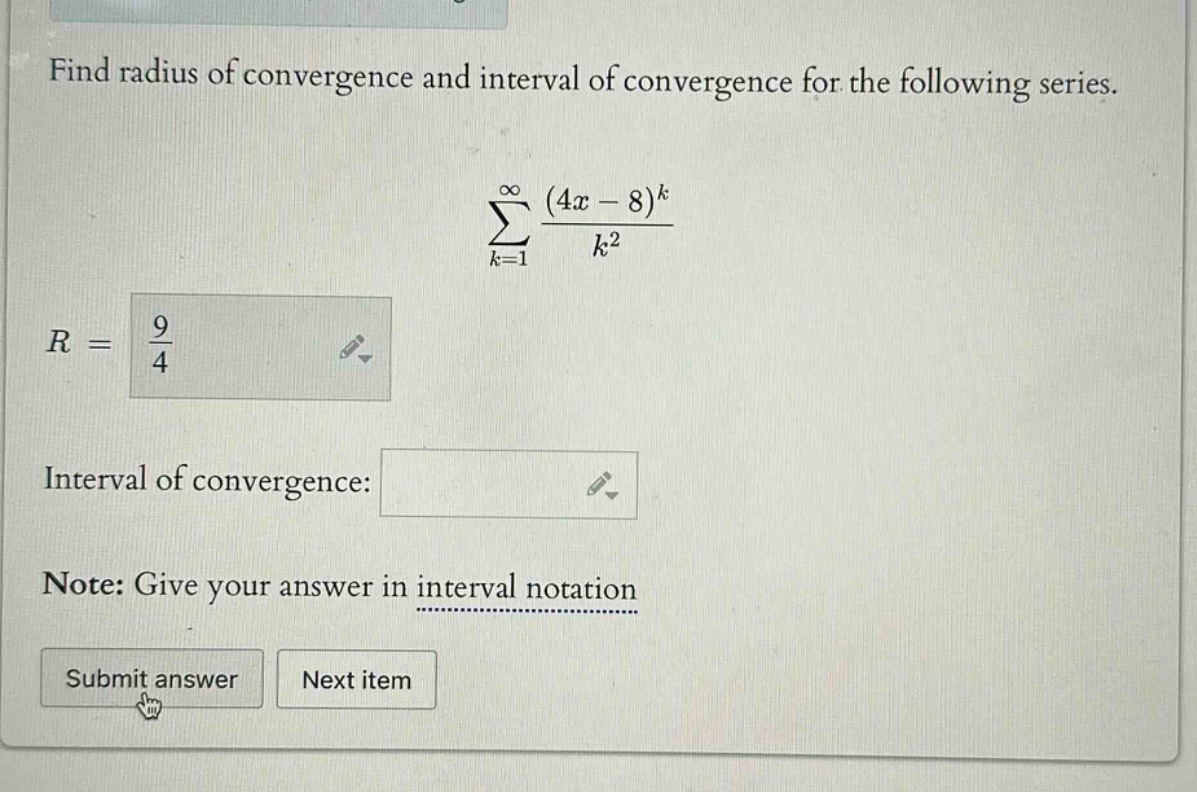
find radius of convergence and interval of convergence for the following series. \n∑(k = 1 to ∞) ((4x - 8)^k / k^2)\nr = 9/4\ninterval of convergence: \nnote: give your answer in interval notation\nsubmit answer next item
Answer
Explanation:
Step1: Apply ratio - test
Let $a_k=\frac{(4x - 8)^k}{k^2}$. Then $a_{k + 1}=\frac{(4x - 8)^{k+1}}{(k + 1)^2}$. Calculate $\lim_{k\rightarrow\infty}\left|\frac{a_{k+1}}{a_k}\right|=\lim_{k\rightarrow\infty}\left|\frac{(4x - 8)^{k+1}}{(k + 1)^2}\cdot\frac{k^2}{(4x - 8)^k}\right|=\lim_{k\rightarrow\infty}\left|4x - 8\right|\left(\frac{k}{k + 1}\right)^2$. Since $\lim_{k\rightarrow\infty}\frac{k}{k + 1}=1$, the limit is $\left|4x - 8\right|$.
Step2: Find radius of convergence
For convergence, $\left|4x - 8\right|\lt1$. Solving for $x$, we first rewrite it as $- 1\lt4x - 8\lt1$. Add 8 to all parts: $7\lt4x\lt9$, then divide by 4: $\frac{7}{4}\lt x\lt\frac{9}{4}$. The radius of convergence $R$ is found from the form $\left|x - c\right|\lt R$. Rewrite $\left|4x - 8\right|=\left|4(x - 2)\right|$. If $\left|4(x - 2)\right|\lt1$, then $\left|x - 2\right|\lt\frac{1}{4}$.
Step3: Check endpoints
When $x=\frac{7}{4}$, the series becomes $\sum_{k = 1}^{\infty}\frac{(4\cdot\frac{7}{4}-8)^k}{k^2}=\sum_{k = 1}^{\infty}\frac{(-1)^k}{k^2}$. This is an alternating - series and converges by the alternating - series test. When $x=\frac{9}{4}$, the series becomes $\sum_{k = 1}^{\infty}\frac{(4\cdot\frac{9}{4}-8)^k}{k^2}=\sum_{k = 1}^{\infty}\frac{1^k}{k^2}=\sum_{k = 1}^{\infty}\frac{1}{k^2}$, which is a $p$ - series with $p = 2\gt1$ and converges.
Answer:
$\left[\frac{7}{4},\frac{9}{4}\right]$