3. find the radius of convergence and interval of convergence of the series ∑_{k = 0}^∞ ((-3)^k x^k)/√(k + 1).
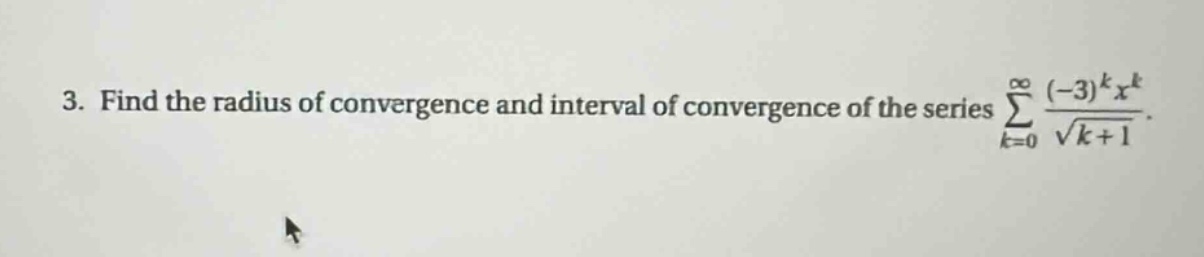
3. find the radius of convergence and interval of convergence of the series ∑_{k = 0}^∞ ((-3)^k x^k)/√(k + 1).
Answer
Explanation:
Step1: Apply ratio - test
Let $a_k=\frac{(-3)^k x^k}{\sqrt{k + 1}}$. Then $a_{k+1}=\frac{(-3)^{k + 1}x^{k+1}}{\sqrt{k+2}}$. Calculate $\lim_{k\rightarrow\infty}\left|\frac{a_{k + 1}}{a_k}\right|$. [ \begin{align*} \lim_{k\rightarrow\infty}\left|\frac{a_{k + 1}}{a_k}\right|&=\lim_{k\rightarrow\infty}\left|\frac{\frac{(-3)^{k + 1}x^{k+1}}{\sqrt{k + 2}}}{\frac{(-3)^k x^k}{\sqrt{k + 1}}}\right|\ &=\lim_{k\rightarrow\infty}\left|\frac{(-3)^{k+1}x^{k + 1}\sqrt{k + 1}}{(-3)^k x^k\sqrt{k + 2}}\right|\ &=\lim_{k\rightarrow\infty}\left|(-3)x\frac{\sqrt{k + 1}}{\sqrt{k + 2}}\right|\ &=\lim_{k\rightarrow\infty}\left|3x\right|\sqrt{\frac{k + 1}{k + 2}}\ &=\left|3x\right|\lim_{k\rightarrow\infty}\sqrt{\frac{k + 1}{k + 2}}\ &=\left|3x\right| \end{align*} ]
Step2: Find the radius of convergence
For convergence, $\lim_{k\rightarrow\infty}\left|\frac{a_{k + 1}}{a_k}\right|\lt1$. So, $\left|3x\right|\lt1$, which gives $\left|x\right|\lt\frac{1}{3}$. The radius of convergence $R = \frac{1}{3}$.
Step3: Test the endpoints
Case 1: $x=\frac{1}{3}$
The series becomes $\sum_{k = 0}^{\infty}\frac{(-3)^k(\frac{1}{3})^k}{\sqrt{k + 1}}=\sum_{k=0}^{\infty}\frac{(-1)^k}{\sqrt{k + 1}}$. This is an alternating - series. By the alternating - series test, since $b_k=\frac{1}{\sqrt{k + 1}}$ and $\lim_{k\rightarrow\infty}b_k = 0$ and $b_{k+1}=\frac{1}{\sqrt{k + 2}}\lt b_k=\frac{1}{\sqrt{k + 1}}$ for all $k\geq0$, the series converges at $x = \frac{1}{3}$.
Case 2: $x=-\frac{1}{3}$
The series becomes $\sum_{k = 0}^{\infty}\frac{(-3)^k(-\frac{1}{3})^k}{\sqrt{k + 1}}=\sum_{k=0}^{\infty}\frac{1}{\sqrt{k + 1}}$. This is a $p$ - series with $p=\frac{1}{2}\lt1$, so the series diverges at $x=-\frac{1}{3}$.
Answer:
Radius of convergence: $R=\frac{1}{3}$; Interval of convergence: $(-\frac{1}{3},\frac{1}{3}]$