a. find the radius and height of a cylindrical soda can with a volume of 339 cm³ that minimize the surface…
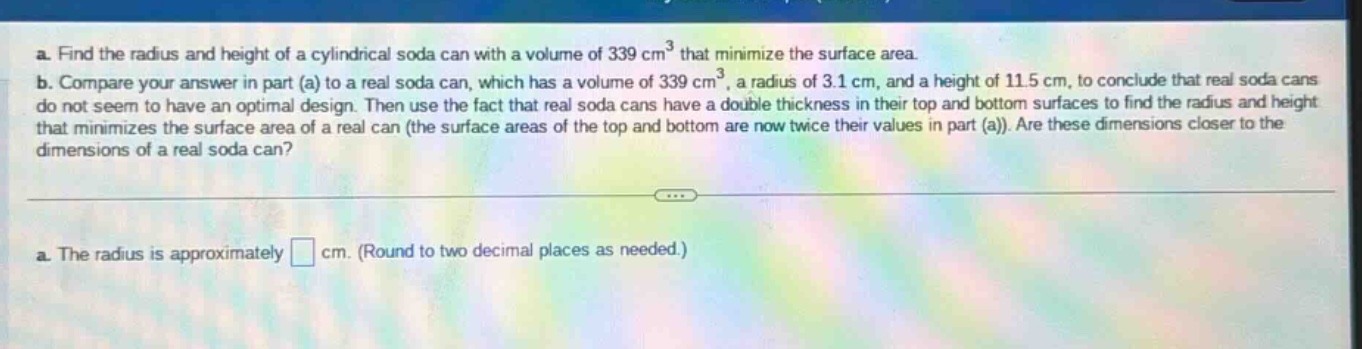
a. find the radius and height of a cylindrical soda can with a volume of 339 cm³ that minimize the surface area. b. compare your answer in part (a) to a real soda can, which has a volume of 339 cm³, a radius of 3.1 cm, and a height of 11.5 cm, to conclude that real soda cans do not seem to have an optimal design. then use the fact that real soda cans have a double thickness in their top and bottom surfaces to find the radius and height that minimizes the surface area of a real can (the surface areas of the top and bottom are now twice their values in part (a)). are these dimensions closer to the dimensions of a real soda can? a. the radius is approximately cm. (round to two decimal places as needed.)
Answer
Explanation:
Step1: Recall volume and surface - area formulas
The volume formula of a cylinder is $V=\pi r^{2}h$, and the surface - area formula is $S = 2\pi r^{2}+2\pi rh$. Given $V = 339=\pi r^{2}h$, so $h=\frac{339}{\pi r^{2}}$. Substitute $h$ into the surface - area formula: $S(r)=2\pi r^{2}+2\pi r\cdot\frac{339}{\pi r^{2}}=2\pi r^{2}+\frac{678}{r}$.
Step2: Find the derivative of the surface - area function
Differentiate $S(r)$ with respect to $r$. Using the power rule, if $y = ax^{n}$, then $y^\prime=anx^{n - 1}$. $S^\prime(r)=4\pi r-\frac{678}{r^{2}}$.
Step3: Set the derivative equal to zero and solve for $r$
Set $S^\prime(r)=0$, so $4\pi r-\frac{678}{r^{2}} = 0$. Multiply through by $r^{2}$ to get $4\pi r^{3}-678 = 0$. Then $r^{3}=\frac{678}{4\pi}=\frac{339}{2\pi}$. So $r=\sqrt[3]{\frac{339}{2\pi}}\approx3.77$ cm.
Answer:
$3.77$