9. find all real numbers that satisfy the equation: sin²x = 1/4 in the interval 0,2π). a. π/6, 5π/6 b. 7π/6…
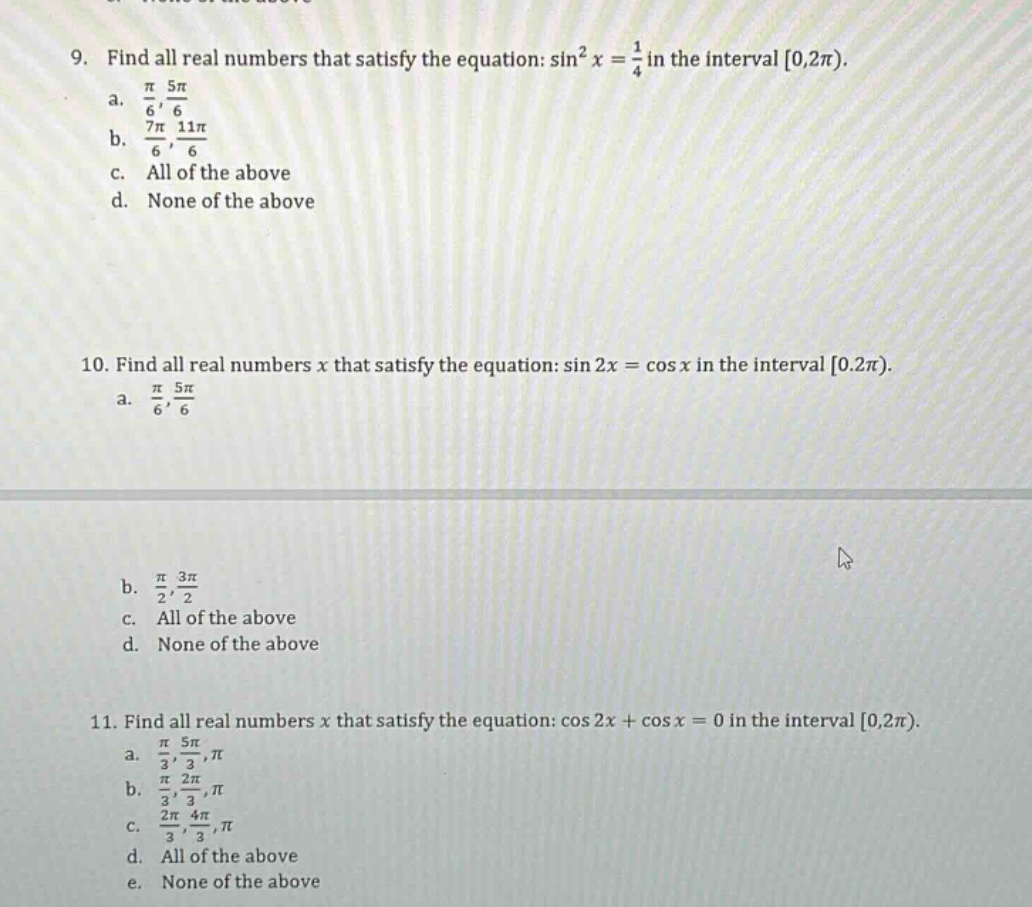
9. find all real numbers that satisfy the equation: sin²x = 1/4 in the interval 0,2π). a. π/6, 5π/6 b. 7π/6, 11π/6 c. all of the above d. none of the above 10. find all real numbers x that satisfy the equation: sin 2x = cos x in the interval 0,2π). a. π/6, 5π/6 b. π/2, 3π/2 c. all of the above d. none of the above 11. find all real numbers x that satisfy the equation: cos 2x + cos x = 0 in the interval 0,2π). a. π/3, 5π/3, π b. π/3, 2π/3, π c. 2π/3, 4π/3, π d. all of the above e. none of the above
Answer
Explanation:
Step1: Solve $\sin^{2}x=\frac{1}{4}$
Take the square - root of both sides: $\sin x=\pm\frac{1}{2}$. When $\sin x = \frac{1}{2}$, $x=\frac{\pi}{6}+2k\pi$ or $x = \frac{5\pi}{6}+2k\pi,k\in\mathbb{Z}$. In the interval $[0,2\pi)$, $x=\frac{\pi}{6},\frac{5\pi}{6}$. When $\sin x=-\frac{1}{2}$, $x=\frac{7\pi}{6}+2k\pi$ or $x=\frac{11\pi}{6}+2k\pi,k\in\mathbb{Z}$. In the interval $[0,2\pi)$, $x=\frac{7\pi}{6},\frac{11\pi}{6}$. So the solutions of $\sin^{2}x = \frac{1}{4}$ in $[0,2\pi)$ are $x=\frac{\pi}{6},\frac{5\pi}{6},\frac{7\pi}{6},\frac{11\pi}{6}$.
Step2: Solve $\sin2x=\cos x$
Use the double - angle formula $\sin2x = 2\sin x\cos x$. Then the equation becomes $2\sin x\cos x-\cos x = 0$. Factor out $\cos x$: $\cos x(2\sin x - 1)=0$. If $\cos x=0$, then $x=\frac{\pi}{2}+k\pi$. In the interval $[0,2\pi)$, $x=\frac{\pi}{2},\frac{3\pi}{2}$. If $2\sin x - 1=0$, then $\sin x=\frac{1}{2}$, and $x=\frac{\pi}{6}+2k\pi$ or $x=\frac{5\pi}{6}+2k\pi$. In the interval $[0,2\pi)$, $x=\frac{\pi}{6},\frac{5\pi}{6}$.
Step3: Solve $\cos2x+\cos x = 0$
Use the double - angle formula $\cos2x=2\cos^{2}x - 1$. The equation becomes $2\cos^{2}x - 1+\cos x = 0$. Let $t = \cos x$, then $2t^{2}+t - 1=0$. Factor the quadratic equation: $(2t - 1)(t + 1)=0$. If $2t - 1=0$, then $t=\cos x=\frac{1}{2}$, and $x=\frac{\pi}{3}+2k\pi$ or $x=\frac{5\pi}{3}+2k\pi$. In the interval $[0,2\pi)$, $x=\frac{\pi}{3},\frac{5\pi}{3}$. If $t + 1=0$, then $\cos x=-1$, and $x=\pi$.
Answer:
- c. All of the above
- c. All of the above
- a. $\frac{\pi}{3},\frac{5\pi}{3},\pi$